Quantcast
Channel: Indie Horror Films
Viewing all 727 articles
Browse latest View live

Reviews: Short Films for February 2018

$
0
0
Text © Richard Gary / Indie Horror Films, 2018
Images from the Internet
Poster can be made larger by clicking on them
Reviews are in alphabetical order, not by ranking

American Virus
Directed by Shane Ryan
Mad Sin Cinema
5:39 minutes, 2015
Short but effective, this transgressive film shows a group of home-grown biological terrorists who release a zombie virus, only to find it literally bites back. Co-written and starring director Ryan and Kathryn Eastwood (yes, the chair-talker’s daughter), it’s done cinéma vérité (rather than it’s ugly stepchild found footage, though there is some of that here, too), following their – err – followers and they roam around the city spreading the disease through injection into homeless people. Its second act is very bloody (as the image attached can verify), and Eastwood, who is both attractive and looks like she can take any of the women on “GLOW,” is a solid force as she mocks the audience. Terrorism isn’t just bombs, this posits, it’s so much more; as the title implies, though, is the real virus the disease or rather is it the people who release it? A really nice release that will just flow by quicker than the virus shoots through the dropper’s neck.
Trailer HERE

Guerrilla
Directed by Shayne Ryan
Mad Sin Cinema
13:05 minutes, 2017
This film is an interesting experiment into late ‘80s style exploitation cinema with colorful pastel lettering that looks spray painted, which makes sense as it takes place in 1989. Without dialog (and with possibly the chance of a sequel which would not surprise me from the exceedingly prolific Ryan), we follow the before, during and afterof a missile that brings a virus to California. We see this through the eyes of a 10 year old girl who shoots 8mm film of what she is witnessing (I wonder who will be alive to process it, but I digress…). She is strong, and trains herself in martial arts, and we get to see some of that action over electronic-ish 1980s style music that sounds like it could be from Rocky. To me, most of the impressions given feel more ‘70s than near 1990 (roller skating, arcades, big clothes, etc.), but it definitely is a beautiful portrait of some longer time gone that I’m willing to admit. It’s pretty easy to follow what the action is despite lacking dialogue, though a series of title cards for different time aspects helps. My fave part, though – and this is me being a media theorist – is the bloopers reel during the credits where Ryan shows how hard it is to shoot a period piece without the achromatic cell phone popping up everywhere. This is true; I recently went to a local (to me) Zombie Walk, and out of 100 pictures, only 15 didn’t have a cell phone it in somewhere. I also enjoyed how Ryan trips from one subgenre to another. This film feels a bit silly, but in a good way, like it was a child making it; I’m assuming that’s the point considering the age of the protagonist filmmaker. Also makes me thing of the mode of something like the Spy Kids franchise.
Film HERE

The Halloween Girl
Written and directed by Richard T. Wilson
Mad Shelley Films
18:52 minutes, 2015
www.facebook.com/pages/Mad-Shelley-Films/304829823050722
I’m a little late on the draw with this one as I lost track of it for a while. I’m glad I had the chance to see this in its original incarnation, which I’ll explain later. I wouldn’t necessarily call this a horror film per se, but it does have a demanding ghost and a Halloween theme, some intense moments, and certainly a heart at its center. In the story, Luke (Nicholas Zoto) is a lonely kid with a sad, alcoholic mom (Christine Parker) who’s recently lost her job (because of her drinkin’?). In the playground, Luke meets and befriends the older and titular Charlotte (Catherine Kustra), whom he refers to as “The Halloween Girl” because of the colors of the clothes she’s wearing. It’s pretty obvious on some level who she is, but yet there still remain some nice surprises in store. It’s beautifully shot, with some nice angles, lighting, and moments that vary between Hallmark and Horror. It makes an enjoyable viewing. Meanwhile, as I was elsewhere, Charlotte has been spun off into the hit horror Web series, “Under the Flowers,” which is about to begin its second season. I think I may check that out, if this is the direction it’s heading.
Trailer for “Under the Flowers” HERE

Heir
Directed by Richard Powell
Fatal Pictures / Red Sneakers Media
13:58 minutes, 2015
Just because a picture takes us on a track that doesn’t conclude in that preconceived direction tends make it better rather than not. This intense tale from Ontario introduces us to a dad with a secret (Robert Nolan) and his barely teenage son (Mateo D’Avino), who travel a distance to meet up with his old college buddy (scream king Bill Oberst Jr.). They share a secret that of course I won’t share, but it’s creepy and it’s green. The first half could have been about any number of social ills plaguing the West these days, but this delves into something deeper, darker, and yes, greener. Everyone does a decent job, but it’s Oberst, who is a naturalistic actor of the highest level, that manages to keep the camera and viewer’s eye. The best way I can think of to describe his character is as follows: as someone once said to me about someone else in real life (as opposed to reel life), he’s just… not. But again, it’s also not what you might be expecting, either. This is a beautifully shot piece that feels a bit claustrophobic at times, which only adds to the chill factor. The Butcher Shop did a great job with the SFX, and there is some fine editing work here, as well. Worth seeking out.
Trailer HERE:

In Darkest Slumber
Directed by JT Seaton
Cat Scare Films
4:30 minutes, 2016

For hundreds of years, many of us grew up with Grimm’s Fairy Tales, which in its pure form were often horrific (and many of which have been turned into genre films). And every once in a while, such as with the likes of Roald Dahl, there will be additions to the canon. Which brings us to this modern fairy tale of a comatose woman (the up and coming Samantha Acampora) who is dogged by a flamboyant evil spirit in modified clown – or possibly harlequin, as that is more trickster – make-up (Jonathan Grout). [As a sidebar, Acampora would make a great petite-yet-sexy Harley Quinn.]. With a flourish language written by the also quickly up-and-coming Michael Varrati, we get a great story and a moral at the end that is true to the Fairy Tale genre. The narration is by the legendary Lynn Lowry. The film has a bit of an ethereal feel to it, as the camera and editing flow a bit like a river, and nice plays with lighting. At less than five minutes, it’s quite the satisfying excursion in Girl Power!

Love Is Dead
Written and directed by Jerry Smith
Sickening Pictures / Dexahlia Productions
10:50 minutes, 2016
As the song says, “Love hurts / love scars…” We learn the truth of that from the two protagonists of the film after a prelude of Peter (porn actor Aaron Thompson) talking to his shrink (genre-regular Ruben Pla, who tends to play doctors in films like Contracted and Insidious). In flashback – and in the shower – we meet the naked and tat-covered Peter, and his equally tatted and naked wife, Mara (Joana Angel, also a porn star, though she is pushing into more mainstream genre-style films). It is obviously not a joyous moment, which leads to further unhappiness. While this is not classically a horror film, the tension is strong. Sometimes it’s a bit hard to make out what the sobbing Mara is saying, but the point is understood. This is Jerry Smith’s second film (both shorts), though is he known more for his writing aboutgenre films¸ so it’s great that he’s actually participating now. He manages to get some decent shots in what is obviously a cramped space, and the story is short enough not to lose the viewer. Yeah, I found the sheer volume of tats a bit distracting, expecting Ray Bradbury or Rod Steiger to show up any second (not really, considering they’re both dead, but hopefully you get my point). It’s a well-made short, and worth the view, depressing as it is.
Film HERE

The Minions
Directed by Jeremiah Kipp
Lauren Rayner Productions
11:17 minutes, 2014
Not to be confused with the Pixar characters which are every-witch-where[sic; pun intended], the title here focuses on William (the veeeery tall Lucas Hassel), who is caught in a bind. He hears Abigail (Lauren Fox) chastising him for getting involved with two “witches’ minions,” the very drunk Katrina (Robin Rose Singer) and her friend Sarah (Cristina Dokos), who is trying to get her home safely. The film plays one of my favorite film thriller motifs of what is real and what is imagined. The film mostly takes place on a dark New York (and Brooklyn) street, with nearly all the color drained out of it, giving it a faint, wan hue to match the mood perfectly. As William becomes more besotted and entranced, events evolve suddenly and sharply. This is a lovely film that plays games with both the characters and the audience.
Film HERE:

Oni-Gokko (Tag)
Written, edited and directed by Shane Ryan
Mad Sin Cinema
8:13 minutes, 2011
Director Ryan takes on J-Horror in this languid yet skeevy story – told in Japanese – about two sisters, Miki (Eri Akita) and Aki (Mariko Miyamitsu, aka Mariko Wordell), who once played a game of tag that did not end well. How much is a ghoststory and how much is a guilt story is left up to the viewer. Razors are one of my ewww points, and it’s put well to use (even if not in close-up). Despite some screechy dialogue between the siblings, the pace is slow with long shots of the birthday suited duo. Even though short, it takes some patience to take it all in. A nice, neo-arty excursion, and I’m glad Ryan took the chance.

Painkiller
Directed by Jeremiah Kipp
Action Media Productions
15:54 minutes, 2014
Even though this film is a few years old, it’s even timelier now when doctors are either overprescribing or removing opioids like Fentanyl due to its addictiveness, leaving some in constant pain, suffering both from withdrawals and the original pain for which the drugs were given in the first place. For this film, through flashbacks we learn about two romantically involved scientists (Thomas Mendolla and the cute Kelly Rae LeGault in an obvious wig) who genetically design a small crab-like creature that, when imbedded in the spine, lives off pain while releasing endorphins. Of course, this being a genre film, there are unforeseen consequences. In a nice touch, it’s not just the effects on the host, but those who are attracted to it. This is solid body horror, but despite its physical harshness, it’s not what I call a squishy, making it palpable, on some levels, to a more general horror audience. It’s well done; the pacing is solid with a nice build-up.
Film HERE

Savor
Directed by Marc Cartwright
Glass Cabin Films
0:15 minutes, 2016
Yeah, sweet and very short. And yet, for its exceedingly brief time on the screen, it actually works as a narrative. Sure, there are no deep philosophical meanderings, nor any kind of subplots and exposition, but there is a bam! If you’ve ever found a hair in your food, this may do more than just gross you out. I don’t want to give anything away because, hey, you’ll get there in a quarter of a minute anyway. Baker Chase Powell, who has a kind of Zac Efron vibe, does well in conveying emotion without words and without much time. This is a really fun watch, and even if you hate it (though I don’t know why one would), shit, it’s 15 seconds of your life. Give it a try.
Film HERE


Review: Inbred Redneck Vampires

$
0
0
Text © Richard Gary/Indie Horror Films, 2018
Images from the Internet


Inbred Redneck Vampires (aka Bloodsucking Redneck Vampires)
Directed by Edward Hegg and Joe Sherlock
Sub Rosa Studios / MVD Visual
77 minutes, 2004 / 2010
www.SRSCinema.com
www.MVDvisual.com


Inbred Redneck Vampires actually began its life in 2004 under the title Bloodsucking Redneck Vampires. Huge difference, hunh?

I’m wondering if there is a future lawsuit in the making from this production, as here is the basic plot: a female vampire decides to raise an army of vampires to wipe out a threat. Did that Eclipse anyone else’s mind?

Well, although the basic storyline pastiche is the same, that is where the similarity ends, and this film is a throwback to those drive-in flicks that rarely made it up north (except perhaps at one of those theaters that was the glory of 42nd Street at Times Square, in New York, now gentrified into oblivion. But I digress…), but did so well in the Deep South, though they were usually about truckers and moonshine, rather than vampires.

This film really is a hoot. There are two plots going on, which of course will converge by the end. While the [Transylvanian?] vampire countess Catherine (Felicia Pandolfi) and her oh-so-not-smart servant / familiar (Warren E.E.B.) work on their plans to (wait for it, Pinky) take over the world, the little town of Backwash (filmed in Winlock, WA), where beer and Dixie flags are common, is slowly transformed during the height of the annual Tripe Days Festival.

This is no 2000 Maniacs, but more a dumbed down Dukes of Hazzard, and I mean that in a positive way. The protagonists of the story is the Poissier (pronounced ‘pisser”) family of Ma (Carrie Davis), sexy daughter Eva (Lindsey Hope), and dumb-as-dirt Lil’ Junior (Rob Merickel). Oh, and there’s Pa who is always off somewhere “tryin’ to read” something. Lil’ Junior (which sounds like a name from The Sopranos, even though it predates it) has a friend, little person Cletus (Bill Bradford), who is rude, crude, and always at full volume, but compared to Lil’, he’s Einstein.

Into this house comes very - er – cosmopolitan French interior designer, Jean-Claude Les Eaux (Scott Shanks), who is shocked by the state of the room he is supposed to redecorate (seems Ma won a contest from a bull inseminating magazine), which is, of course, the bathroom. Along the way, this Parisian poisson out of eau slowly but surely comes to an understanding of the town and its folks, just as they begin to “turn” into Catherine’s intended army.

But it seems Lil’ Junior ain’t the only one with the porch lights on and no one home, as, well, I don’t want to give it away. It actually is smart in its own silly way. For example, the local house of worship is the Church of St. Festus the Tipsy.

The acting is a bit, well, local theater, but the cast give it their all, and they seem to be having a lot of fun, which in turn comes across to the viewer. As with just about all indie films of this type, one has to put their reality check into a closet with Jean-Claude, and enjoy the ride. The script is actually quite witty in spots, when it’s not trying to out coarse Porky's-type material. In fact, there’s more “gross out” than gore, but I would also like to add that there was more than one time I actually had a good laugh. Intentionally.

This isn’t Scorsese (but these days is Scorsese Scorsese?), but it’s not Ed Wood, either. This is a romp, and should be seen as such. People in the south will either see this as an extension of some of the – er – southsploitation films of the ‘60s and ‘70s, or will be highly offended. Either way, we up north can laugh, and hope they’ll join in.

There is a full film commentary, lots of trailers, an amusing and relatively extensive behind-the-scenes featurette, and a decent blooper reel.

This review was originally published in FFanzeen.blogspot.com


Review: Inoperable

$
0
0
Text © Richard Gary / Indie Horror Films, 2018
Images from the Internet

Inoperable
Directed by Christopher Lawrence Chapman
Zorya Films / Millman Productions
85 minutes, 2018

It’s wonderful how Danielle Harris turned a cutesy television acting career (for example, I first noted her as a regular on the 2000-2002 show That’s Life, where she played someone named Plum) into becoming one of the top of the current scream queens. Sure even back then she was doing a horror turn now and again, but it’s in the indie horrors that she really took off and reach her fan base.

The reason I bring this up is the very diminutive in stature but equally big in style Harris is the star of this new straight to DVD/VoD film. She plays Amy in this play on the repeating Groundhog Day theme from hell that also has just a shade of Grave Encounters (especially the sequel). Mixing the events of a day stuck in the middle of a traffic jam with continually waking up in a hospital of the damned, she slowly starts to put pieces together. An interesting aspect that extrapolates from the now-classic Bill Murray comedy is that every time Amy awakens-like-the-Force, while there are some repetitions, the scenarios change drastically, such as either not being seen by those around her to her being attacked by them. We (and she) quickly learn that the staff running the place has no compulsion on using scalpels, drugs or electro-shock “therapy.”

With each reoccurrence, the violence gets more severe (and usually in close-up), either to her or those she views around her. As all this is happening, the well-chosen and  presciently named Hurricane Sybil is looming in on her locus, centered in Tampa Bay, Florida. One constant is the blonde woman who wanders the hall sloooowly (Crystal Cordero), popping in and out at will.
                             
In one incarnation, she meets two people: a cop, Ryan (Jeff Denton), and the dressed to the nines Jen (Katie Keene). They are also part of the repetition on the side of the prey, as well as giving Amy some chance to work out what is going on (and for the audience as exposition, as well). They suspect that there are a series of timelines that are being affected by the hurricane having done something to an army base experiment. Honestly, it’s not very clear and seems farfetched, but so what. It’s what is going on in this story that is germane more than why.

To keep if further interesting, the time shifting progressively happens faster each time, so there is no reason to feel the same-old-same-old, even with the repetition. Speaking of the temporal, I was wondering either when this story was actually filmed, or perhaps when it was supposed to take place. For example, Amy has a flip phone, the computers are all desktop and the monitors are cathode tubed with the big backs. Honestly, the flat screen televisions in the hall that keep us all updated about the hurricane’s location feels a bit achromatic to the rest of the technology, even if their images look more analog signal than HD digital.

All these different time scenarios give the chance to present the audience with increasing levels and reasons for gore since characters can be sliced and diced more than once, so that’s not a bad thing, right? And why is all this happening? Aye, that’s the question of the day, ain’it?

This film plays with one of my favorite devices of speculating how much is in the mind and how much is in the reality of the characters. From early on, I had a theory of what was going on, and the reasons for it. I was 90 percent wrong, I’m happy to say, and that says a lot about the film.

Of course the cast is strong, as most of its players have a long list of credits. But there are some other aspects of the film worth noting. For example, the camera and dolly work is superb, and of special note is the editing. Working in the repetitions by seamlessly cutting out the recurring actions though editing is a good way to support of the story without annoying the audience. There is also a lot of motion in the physical sense as well, as we watch Amy do a lot of running down long hospital hallways. I was exhausted just watching her.

The gore is thick and rich throughout, including (but not exclusively) by use of needles, surgical saws, and scalpels. There is a lot of body cutting (etc.) that definitely falls sort of torture porn but can probably be considered body horror. Add the psychological twists and turns and it’s a pretty full package.

Image result for inoperable keeneThere is also a very subtle and dark humor that occasionally pops up, such as a comment Amy makes upon waking up for the umpteenth time (I’m not going to give it away). There were a couple of moments here and there, though, where I thought the film lagged a bit, mostly around phone calls. Mostly, though, it’s a pretty taut thriller and the cast is certainly up for that. Harris and Keene (most of the time saddled with some horrendous shoes) are up for the task, and both have their moments to shine, throughout.

What really keeps this film from being like any other time looper is that every time it happens there are some repetitions (especially around those damned phone calls), but as I said, the story changes enough each time that even though there are familiarities, it morphs enough to keep the suspense going.

There are also the rare plot holes, and certainly I have a few questions (though most of them I can’t ask here without giving away too much), but one of the nice things about this kind of story is that because of the overlapping and forever shifting timelines, it’s easy to lose and explain away the holes in the different directions.

That being said, this is only the director’s second feature (the first being non-genre), and he handles it exceedingly well for such a complex story. That’s pretty exciting.


Review: The Rise and Fall of an American Scumbag

$
0
0
Text © Richard Gary / Indie Horror Films, 2018
Images from the Internet


The Rise and Fall of an American Scumbag
Written, cinematography, directed and edited by Dakota Bailey
R.A. Productions
38 minutes, 2018

Here is the generalized truth about evil people: they do not realize they are terrible citizens. Those who bomb abortion clinics, marched in Charlottesville, the person coming into your home and stealing your goods to sell for drugs? They rationalize that the ends justify their means, or that they are doing what they believe is necessary, or they just think that you are the evil one for letting women vote, letting darker skinned people into the country, or not bending down to idolize whomever they idolize in however way they idolize their idol (more on this later). This includes the Westboro Baptist Church, the mufti of wherever calling for jihad, or even what has become known as the Taylor Swift Army.

Dakota Bailey
Lower class whites in poor neighborhoods and ghettos, the drug addicted, murderous, lecherous, down and out folk who will do anything to not live, but merely survive, are the focus of director and actor Dakota Bailey’s stories and lens. He calls himself an auteur, and he certainly is one of the few who could actually be covered by that term in its truer and literal sense. Not counting his short films, this is his fourth full length release made with non-pro actors who know how to get the job done. Sometimes I wonder where the stories start and the people end. And in Bailey’s stories, a lot of people “end.”

This is a sequel to American Scumbags, released in 2016 (reviewed by me HERE). It brings back some of the characters who actually managed to survive the first blood-splattered collection of three intertwining stories. The remainders are mostly a viscous nutjob control freak named Billy (Darien Fawkes), and Johnny (director Bailey), a hitman who kills for his drug needs.

Once again we visit the still ironically named city of Sunnydale (filmed in Denver), where it seems like it may be the location of a Dante-eske Purgatory or even the other place. The five interlocking stories could be the overlapping rings of Hell and each member lives in their own mind-world, often connected by cell phone more than the physical; they are often in motion through foot, wheelchair or pick-up truck, and hats and wigs often seem of play an indirect part in separating the head from the space they occupy, as a shield or barrier.

Darien Fawkes
While Bailey’s films have all followed the auteur’s path, including title cards and persons descriptors (e.g., “Billy: Sadistic Sociopath”) in a similar font, monochrome tinting of the visuals, and using friends as the characters. However, he still finds room to grow. For example, in this release, we often hear what characters are thinking, which is a much better touch than just hearing them speak on cell phones to gather what is their motivation. Bailey’s editing skill is also improving; with more fluid scenes and less jump cuts, making the film’s pacing easier and less jarring, allowing us to focus on the content more than the form.

There is also a lot of both Christian and Satanic imagery, in both blatant and subtle forms. For example, there is a “666” written inside a file cabinet drawer or a Devil graffiti, but there is also the Novena candles that line the sides of the road (my fave is one of Jesus holding two guns in his folded arms), or Christmas decorations, many of which get mashed. However, this is the first Bailey release I can remember where Satan himself doesn’t make an appearance directly.

Marla Rose
So, what I’m saying is that there are two ways one can look at this specific aspect of how the film looks at religion: one is that it is totally against the totalitarianism of the Religious Right (or, as I once heard it called, Political Christianity) and how that helps destroy societies. The other is from the perspective of a hyper-Christian, who probably sees that being a non-Christian leads to drugs, murder and Satanism. I’m quite sure this leans towards the former, but the latter should be acknowledged. If you read my reviews regularly, you know where I stand (just ask).

The main character of the film is the aforementioned Billy, who is also the most interesting to me. Fawkes’ drawl, missing front teef, knee-length black coat and black hat make him both hateful and interesting at the same time. He’s out to score some money by any means necessary, and drugs for his very cute girlfriend, Candy (Marla Rose). Mind you, this is pretty much the norm as nearly everyone is seen doing some kind of substance abuse throughout. Bailey is also drug-addled as a hitman on his way up, and his vicious no-compromise dealer is Pat (Alaskan Cinder). Other characters float in and out of these stories, but most either are blown away or do the slaying, though they are key turning points in the storyline. As none of these are “professional” actors, the level of skill is variant, but some such as Fawkes definitely hold their own.

One lesson learned from this film is if you are going to be a drug dealer (and I am certainly not recommending that as I’m pretty strait-edge), don’t also be a user because it clouds your judgment; of course, being a dealer is not a great judge of judgment either. Another lesson to be had is taking heroin and thinking it’s cocaine is not a good thing.

Alaskan Cinder
The five chapters are kind of superfluous as the stories are so intertwined they flow as one narrative, but I like that it’s broken up that way, with titles like “Drugged Up & Dead to the World,” “Ghosts of Addiction,” and “The American Dream is a Fucking Lie.” Yeah, it’s quite nihilistic, but that’s the world Bailey is putting under the microscope. Many of the “larger” films focus on the crime world, but Bailey’s releases feel like you’re right there. Also, while most mainstream films tend to present this types as characters as African-American, Latino or some other form of Other, Bailey uses White actors that put it right in your neighborhood. That’s one of the things I like about his films, and each gets better stylistically and story-wise.

The music is loud and blaring, by the hardcore death metal Skullcrack, which fits the film well. It may be a bit on the short side, but there is no padding whatsoever, so you get as much action in this amount of time as in most 80-90 minutes releases.


Review: Hollow Creek

$
0
0
Text © Richard Gary / Indie Horror Films, 2018
Images from the Internet


Hollow Creek (aka Haunting in Hollow Creek)
Written, produced, directed by Guisela Moro
Newfoundland Films; First Edge Films;
Cinematic Motion Pictures; FilmRise; MVD Visual
116 minutes, 2016

I love it when I get to see a horror film written and directed by a woman; in this case it’s Latina actor Guisela Moro. She takes a number of different subgenres and mashes them into an expansive story that lasts nearly two hours (usually a long time for an indie flick), which I will now discuss without giving away toomany details, of course.

Steve Daron and Guisela Moro
We are introduced to married horror writer Blake Blackmore (dashing Steve Daron, who continually has a Sonny Crockett-type 5 o’clock shadow) and his mistress, Angelica (the lovely Moro), as they head out to a cabin retreat in a not largely populated small town in rural West Virginia (hillbilly genre). It seems some young boys have gone missing recently in the area, but our protagonists are more focused on their work and – err – play.

But it’s very shortly into the story (which is why, in part, I bring it up) that other supernatural happenings start to crop up in the house (haunted house genre) that are somewhat subtle to them, but are used well for jump scare type shock value to the audience. There is also the bit about the trio of missing boys and the investigation into finding them (“Criminal Minds-type genre). They all interplay together well into a comprehensive story with a touch of the supernatural without being overwhelmed by it.

In the first act, the ghostly stuff is well timed because in the beginning there are some dialogue-heavy moments of exposition that drag a bit due to some forced language, such as the over use of the endearing-babble word “babe.” But they are interrupted by those nice scares that livens thing up quite a bit.

Sharon Bleau and Alyn Damay
The questions that arose for me were concerning the film’s intentions. Is it a good ghost or a bad ghost? Are the cops the good guys or the bad guys? The only two things that are a given pretty much right from the onset is that Blake and Angie are the side of light, and Leonard (Alyn Darnay) and Nancy Cunnings (Sharon Bleau) are the in the dark region. As it’s given away quite early on (and even in the trailer) that it’s the latter, rednecky farm couple who are behind the kidnappings, But again, what are the reasons and intentions for the sinister duo to be carrying out what they are doing? That is part of what kept my interest.

Here is the thing about small towns: they can amazingly rally up behind you, or give a strong cold shoulder if you are (gabba gabba) not one of “them,” meaning if they turn their back on you, it can be isolating. I’ve been through small towns in West Virginia, and other than the Dixie flags a-flyin’, I got along with everyone I met, even as a stranger, but if I had taken an action that was disapproved of by the group by breaking a code of honor, that situation might have turned into something else. When Angie suddenly disappears, Blake gets a taste of this from the locals as he gets blamed for her going poof! in the rainy night in the court of public opinion, thanks to a sensationalist-driven local media (as we were taught, “If it bleeds, it leads”).

When the second act starts, after Angie vanishes from the town (but not from the story), is when the tale really starts to build momentum. While the film centers on the kidnapping story as its core, it manages to not overuse the ghost or hillbilly aspects of it; rather, Moro wisely plies the other two as aspects of the wholestory, which actually helps make it stronger. Yeah, there are some gothic cliché’s, such as a child’s baseball mysteriously and nosily dropping down the stairs, which has been a standard ever since The Changeling in 1980; however, the orb is key to the story, so in this case it’s not just a ghostly announcement of presence.

Do I really need to say who this is?
The big cameo, of course, is Burt Reynolds, who shows up for one decent scene with Daron, and a brief one later on. Now, Daron has announced that Reynolds is one of his acting idols, and the writing credits state that Daron is “collaborating writer.” My guess is he wrote the scene with Reynolds, which just consists of the two of them. I will further posit that while the film was shot in West Virginia, the scene with the frail, then 80-year-old Bandit, was filmed in Florida where Reynolds lives. The second scene just shows the back of the heads of the cops, so I’m guessing all his scenes were added in after the principal shooting. I would say that it is a cool thing.

The one big hole to me is that there is a rifle hidden in the closet where Blake is staying. This makes no sense, as the cops think he is responsible for Angie’s disappearance, wouldn’t they have found the rifle in searching the house? It’s not like it was hidden somewhere, it’s right on the shelf at the top of the closet. I’m just going to put it up to a rookie writing mistake, and mosey on.

The cast is really strong here. Both Moro and Daron carry their roles well, Bleau plays woundedly cracked just a tad overboard (though her character, well, actually is), and Darnay definitely steals his scenes as the always seething patriarch of the kept clan. He has this way of moving his mouth as a sign of annoyance (you can see it in the trailer) that says so much about Leonard.

Once past the initial “Hey, babe” scenes, the film turns into a really taut, well-written thriller. Even if one edited out all of the supernatural aspects, the tension would still be on high, and that’s great. Having it in, though, is a boost as a way to take it to another level to apprehension. Plus, the way the film was shot, with the effective lighting (including being able to see the action at night) and slower editing, brings a strong and satisfying end result. I look forward to seeing more of Moro’s work as actor, writer anddirector. Brava.


Review: True Love Ways

$
0
0
Text © Richard Gary / Indie Horror Films, 2018
Images from the Internet


True Love Ways
Directed by Mathieu Seiler
Grand Hotel Pictures; Klusfilm Berlin;
ARRI Film and TV Services; Synergetic Distribution; MVD Visual
95 minutes, 2015

Germany is familiar with cinema of the strange in the past few decades. Just look at the likes of the extremely other-there Nekromantic (1987), or even Run Lola Run (1998) as examples.

Anna Hausburg and Kai Michael Muller
For this film, named after a Buddy Holly posthumous rock’n’roll romantic classic from 1960 (which we hear more than once in the film), it opens on the strained relationship between our heroine, Séverine (the lovely Anna Hausburg) and her boyfriend Tom (Kai Michael Müller), with the former telling the latter that she doesn’t love him, but rather has given her heart to someone of whom that she dreamed; to me, his reactions says a lot about why she needs to dump his ass.

Speaking of reactions, the first couple of acts of the film are set at a very languid pace, like being on a rowboat meandering down a river, with little dialog, as Séverine sits in a park watching people, spending the night by herself, or driving down the road chewing both her hair and gum with the camera mainly focused on her face. Within those times, however, there are some disturbing moments of her wondering, “okay, who should I trust?” This paranoia also is placed on the audience by some creepy goings-on that I will very lightly touch on to not give too much away.

Muller and David C. Bunners
At a bar, after Séverine chucks Tom outta da co-joint for a few days, he goes to a bar where he meets Chef (David C. Bunners), who suggests that he will kidnap Séverine and then Tom would come to the rescue and be her “Tarzan.” With other events that happen in the meanwhile, during the ebb and flow of the day mentioned above, the audience can’t help wonder if this is part of a larger event.

About half way through the film, the pieces of some of the events that happened before and why the Chef is so interested in Séverine start to become clearer. And yes, it’s even creepier than you’d expect. We get to figure it out the same time as her, and that’s when the film shifts gears into overdrive. Yet, and this is where I find the film is playing with us, there are still moments of long silence and little movement, that in the heightened state of tension and adrenaline, are nail-biting thriller moments. Again, you know Séverine is feeling the same. It’s really well written that the audience gets to not just sympathize, but empathize, because you’re feeling a bit of what she is experiencing (without us being in real danger).

While definitely a sharp (and occasionally darkly humorous) thriller, some have referred to this as a kunstfilm(art film), and not just because it’s in black-and-white. It’s the pacing, the way the music works with the film beyond jump scares, but it’s not obnoxiously so. In other words, most art films try so hard to be ar-tay, that they become obtuse and confusing. There is none of that here. There are also few weird angles, other than multiple long close-ups of Séverine’s face.

The good news is that Hausburg is talented enough that with the extreme close-ups and lack of dialogue, it still is easy to read the broad emotional range she expresses (i.e., no “Blue Steel” vs. “Magnum”).

As always, the bad guys underestimate Séverine; while she’s no hired assassin like in the predictable and ordinary Final Girl (2015), she is extremely resourceful and works her way through situations (which we get to watch, step by step by facial expression).

The one cliché that is easy to predict in the film regards a tavern owner. I actually said, out loud as soon as she walked into the bar, “Oh, really?! C’mon!” But in a film that’s over 90 minutes, I can forgive it considering how much else is going on.

What really drove me crazy is the Tom character. Hero? Villian? No matter, he’s an asshole, that’s for sure. I’m not going to go into details, but like the male protagonist in Run Lola Run, I have no respect for him.

Sometimes arty films can be especially bloody, such as with Nekromantik, or Miike’s Audition (1999), and while it’s not overly done or in super-graphic detail like many Euro-body horror releases, there is definitely a spurting of the stuff. That being said, there will be a contingent with whom I agree to some level, who will argue that the males are killed pretty quickly, but it’s the women who receive the brunt of the brutality.

Okay, I know I’ve made a couple of complaints, and they seem valid to me, but overall this is quite the stunning picture. Sure, not necessarily a date flick (depending on your companion, of course), but it really is a beautiful piece of cinema, and much of that is directly is in the lap of Hausburg and her mighty-fine acting. My fear is that it will be remade in the Western Hemisphere, and the Séverine character will be played by someone like Chloë Grace Moretz or Abigail Breslin (who’s IMDB’s bio laughingly states is one of the “most sought after actors of her generation”), who cannot really do the heavy lifting acting that would be necessary to match Hausburg.

The only extra on this DVD is the chapters; the captions are imprinted onto the film.

Séverine certainly lives up to her name. Loving her would be severe, and threatening her would be even more so, judging by the actions here. She’s a bit nuts, but borderline enough that you’d have to be intimate with her to see just how around the bend she is. Part of the explanation and what is interesting on a few levels is that the ending is both a WTF and an Ohhhh-I-seemoment. You certainly don’t see that occur much anymore.


Review: Brackenmore

$
0
0
Text © Richard Gary / Indie Horror Films, 2018
Images from the Internet


Brackenmore
Directed by Chris Kemble and JP Davidson
Caragh Lake Films; Upstream Films; MVD Visual
72 minutes, 2016 / 2018

When I was in grade school, I had a teacher who posited that if our room was sealed off from the one next door, after 100 years or so it would probably be hard for the two classes to understand each other. I didn’t know what she was talking about then, but it stuck with me, and has resonated to me throughout my life.

That is sort of the premise of films like this and, say, The Wicker Man (1973) and Jug Face (2013), where remote villages come to have different gods that call on sacrifice and odd worship. For this film, it’s the isolated Irish titular town, where people mysteriously and regularly show up sneaking around in white death masks and stereotypically cultish long robes with cowls. No one ever does mention the Old Ones, though.

I
nto this peculiarity comes lovely Kate (Sophie Hopkins), who is summoned from London because her uncle has passed away, leaving her his modest estate (okay, small house) in town. She was born there, and is told to be his only living relative after she survived a car crash in her youth that killed her parents (i.e., the films prologue).

Everyone is acting oddly around her giving off a “what’ca doin’ in these here parts, stranger?” vibe. It’s pretty easy to figure out that the game is afoot, especially thanks to those masked folks showing up on the story’s periphery, circling ever closer. The lodging house in which she is staying and the lawyer handing the real estate in the late uncle’s will are, in the words of a friend of mine about this kind of thing, just not.

She gets cozy with a local named Tom (DJ McGrath), who shows her around town, unbeknownst to her hubby Allyn (Joe Kennard) back in London Town. While there are other people in the town, essentially Tom, the boarding house couple and the lawyer are just about all we meet in talking roles for the locals. We also don’t get to see too much of the town proper, as it seem to focus mostly on the indoors, other than the front of the houses on which the story focuses and a bit of the wooded area around the lake.

Events start to ramp up on this idyllic spot as someone in a mask and, yes, a cape with a cowl, attacks Kate, but she proves resourceful in what feels like a better way than most films that have women just be blade-fodder. Of course, the local constabulary accuses her of a night gone wrong, what with the attacker being a local and she being a…

It’s hard to tell in the story, and I liked this, whether certain actions are meant to scare her off into leaving, acts of retaliation of local vs. foreigner, or forcing her to stay. I guessed right, by the way.

There are little and subtle things that caught my eye though. For example, in the lawyer’s office there is a binder on a self behind Kate that has, in handwritten letters, 1916. This is an important date in relatively modern Irish history being the same year as Éirí Amach na Cásca, also known as the Easter Rising. No wonder the cop was critical about someone from London.

Along the way, there are hints about what is happening, such as a radio station going wild in the prologue, but mostly the story follows a line that feels familiar, with some elements that have been seen before in these kinds of genre films, even as far back as some Hammer Films,

The film is beautifully shot, and Hopkins is certainly easy on the eyes; she reminds me a bit of Kiera Knightly (if the latter were attractive), being lean of form and a strong chin. Smartly, the film goes for the tight, near claustrophobic closeness of the village, making it seem even smaller than it probably is (filmed in County Cork), especially since we are focused on a particular group of people. Of course, it also is a good way to keep the budget down (which I respect).

There are definitely some clichés here and there, and the big reveal of a specific person is a duh moment, but there are others you may not see coming, so I guess it’s still a “win.” While the ending is enjoyable, it also is a bit unclear. Call me crazy, but it feels like at one time this was a slightly different story, and they edited certain parts out (might explain there being two directors?). For example, during its filming, the working title was Banshee: Beyond the Lake, and there is even a Banshee listed in the IMDB credits, but I don’t remember seeing one. I enjoy Banshee stories, and I was puzzled. Perhaps in the sequel (which I would happily watch if there is one), or in a Director’s Cut version? I’m not sure. But what I am positive of is that I would have liked to have heard a commentary track that might answer some of my questions. Again, perhaps the Director’s Cut version at some point will do this. Meanwhile, the only extra available on this DVD is the chapter breaks.

The cast is all great, with Hopkins being outstanding by expressing a large range of emotions, and the accents don’t be doin’ no harm, either. There aren’t too many bloody scenes, but when it’s there, it’s a cornucopia of the red goo. A couple of other really good SFX appear here and there from Pitch Black Films, as well. Despite it all and because of the acting and cinematography¸ I’m happy I had the chance to see this, though I’m still scratching my head justa bit.


Review: Lights Camera Dead

$
0
0
Text © Richard Gary / Indie Horror Films, 2018
Images from the Internet


Lights Camera Dead
Directed by Tim Reaper
Sub Rosa Studios / Asthesia Productions / Duke Studios /
White Lightening Productions / MVD Visual
80 minutes, 2007
www.SRSCinema.com
www.Lightscameradead.com
www.MVDvisual.com


Independent cinema can be quite inconsistent. Sometimes you find utter trash, and other times you end up with classics like Re-Animator or Evil Dead. Well, Tim Reaper (aka Tim Moehring) hasn’t quite given us an equal to those two, but I will say that this sets a pretty damn high bar.

What better way to formulate a horror flick than to make one about the making of one? Lights Camera Dead [LCD] starts off with auditions for actors and crew for a below low budget film (to be shot on VHS!), called “The Music Box.” The audition scenes are hilarious as even the real director gets to have his cameo as a southern mumbler. Some of this footage is in the trailer, attached below.

The premise, written by Tim and his wife, who is also one of the key characters in the film, Monica Moehring, is quite simple and explained on the box: Halfway through filming, a fed up cast and crew quit, thus shutting down production. But not for long…the fast, efficient filmmakers devise a plan to “finish” off their flick…and there will be blood.

While this is actually a decent sized cast, the main core stands at five:

Amy Lollo is the female lead, and the core of the troupe, keeping the meta-production together, though thoroughly underappreciated by the director and writer characters. Lollo is strong in her role, and plays various emotions well. She has a strong Sarah Michelle Gellar vibe and look going on. When she confronts her boyfriend, I actually backed up on the couch and cringed. That’s effective.

The other female lead is Monica Moehring, another alpha woman whose chest is referred to often (remember, she is one of the writers), but never seen bare because as she explains in one of the commentary tracks, and I found this quite amusing, when she is not filmmaking, she is a school teacher. Her facial expressions as she tries to explain what is going on to a drunken redneck (their word), played by director Tim’s actual dad, who apparently really was drunk, is easily one of the most amusing scenes in the flick. Kudos, dad! Monica has a couple of other acting credits, in films associated with this same production group.

Coldon Martin seems to act by widening his eyes until there is all white around the pupil, but he is also a decent comic relief, especially thanks to a good sense of timing. I have to say he looks quite a bit like a rockabilly version of Casey Affleck. He plays a crew member (and also does the same in the real production, apparently) who is good bad, but he’s not evil. Well, maybe… This is his only official acting credit.

J.C. Lira plays Steven Dydimus, the writer of the doomed production, as well as the “monster” in the rubber mask that is supposed to be a demon from hell. A frustrated horn dog, his level of violence – not expected for his milquetoast character – escalates throughout the making of the meta film. Again, this is his only official acting credit.

Last is Wes Reid, who plays the desperate and borderline – and then over-the-line – psychotic director of the picture, Ryan Black, who will do anything to get it completed. As the horror film is being created, he turns more and more dictatorial, and blames everyone else for his own short sidedness and lack of ability. Wes is becoming sort of a touchstone for Jonathan Straiton’s productions, with a half-dozen of them under his belt; the trailers for most can be seen in the special features section of this DVD. Wes’s weight changes dramatically throughout the film, up and down, as he was also acting in other roles while LCD was being filmed down in Virginia.

While some of the film has that shoestring feel, the cast and crew make the most of it, and seem to actually be enjoying their working together. There is also some interesting writing and filming involved, such as when Lollo’s character is trying to decide whether to open an envelope from her ex-, while he comes to her in her mind in both loving and abusive modes (you can tell which by what he is wearing); this moment also produced the best fright, but I won’t give too much of it away.

I guess I should mention that Richard Christy, of the Howard Stern Show, makes a manic cameo as a music soundtrack writer (this is the only scene shot in Brooklyn, NY), which is amusing, but gotta say I don’t listen to Howard Stern, so I have no idea who Christy is, but his brief commentary on the special features shows that his character in the film is pretty damn close to the real guy. Five minutes long, and he was having trouble figuring what to say.

Anyway, I liked LCD, and from the one indie film I worked on, there is some level of truth to the goings on in this type of production, sans the gore and killing, of course (even though our shoot stayed friendly).

It should be emphasized that this is also a pretty humorous film coming from a very dark, dark place. Fairly put, this film is more purposefully funny than unintentional, much in the way as are the other two films I mentioned in the first paragraph. So go grab a beer, sit back, and enjoy.

Speaking of beer, the full-length commentary on the film is quite fun in most parts, but somewhat annoying in spots. There are four or five people there, including the core of the production staff and some actors, which makes it a bit confusing, though the conversation is usually lively even as they tend to talk over each other (ironically, the video editor of “The Music Box” within the film makes that very complaint stating that it’s hard to edit because of it). People walk in and out of the range of the microphones, there is occasional talking in the background so it’s hard to make out what people are saying near or away from the mics, and at one point, Tim says to Monica, who has left the mic, “Hey, bring me a beer.” You can often hear the tabs being pulled on the beers throughout the commentary. While it’s a bit of a mess, there is still a lot of good information about the writing and making of the picture, so I still recommend it.

So other than the full length commentary, the short Christy comments, and the trailers, there is also an earlier shot short film (2005) by Tim Reaper Moehring called… The Music Box, which is actually not related to the main feature, except the same box appears in both. It is pretty bad and amateurish, shot on video, and shows just how much Tim learned between the two, because the main feature is so much better. It’s more interesting as a historical document in comparison than as a stand-alone short.

I’m grateful films like this get made, because as fun as mainstream horror films can be, it is the indie films like this one that tend to be made by fans, and so there is usually quite a bit of heart. And in this particular one, a bit of intestine, as well.

Originally published in FFanzeen.blogspot.com


Review: Red Krokodil: Director’s Cut

$
0
0
Text © Richard Gary / Indie Horror Films, 2018
Images from the Internet


Red Krokodil: Director’s Cut
Directed and cinematography by Domiziano Cristopharo
The Enchanted Architect / Unearthed Films / MVD Visual
80 minutes, 2012 / 2018

I saw the first two films that Domiziano Cristopharo directed, House of Flesh Mannequins (2009) and The Museum of Wonders (2010). He’s released at least 20 films since then, so I was curious. His style is very artistic and precise, so after nearly a decade, I’m glad to see what this Italy-based artiste was working on – even if this film is five years old, though now it’s getting a new Blu-ray release.

As the opening title card tells us (and I am abbreviating a lot), Desomorphine, a real opioid drug that originated in the US in the early 1930s and is now made and used recreationally in Russia, Produced in this way, it’s made of corrosive materials mixed with Codeine from over the counter products, and is nicknamed “krokodil” due to the blistering skin around injection sites.

At a snail’s pace, we meet Him (Brock Madison). He’s a mess on so many levels, spiritually and physically. His clothes (when he’s wearing them) are filthy, including dark stains on the bottom of his untidy whiteys, there is what looks like mold everywhere, he is unwashed and unkempt, and is missing his two front teef.

We watch much of what happens to him, as he repeatedly gives himself shots from the same needle, goes through withdrawals until the next injection, and segments of overseeing him fitfully sleeping. The viewer gets the feeling of claustrophobia as he moves around his small room; he is practically the personification of the description of the Divinyls song, “Elsie.” 

While filmed in Italy, this takes place in Russia; however, the inner monologs we hear are in English. Because of his drug addled mental state, we get to share what he sees, be it a giant Bunny Man (Viktor Karam) or a bandage swathed Monster (Valerio Cassa), who are the only other characters in the film, albeit in brief snatches.

The only dialog we hear other than grunts and groans is Him’s inner thoughts, which are usually a mixture of stories of his life (e.g., why a stuffed crocodile is important to him), a description of his dream visions, or philosophizing about his hallucinations. One example is when he seesa mannequin face inside a hole in the wall, part of his treatise as he smiles is, “God is watching me inside the eye; the whole universe is inside the eye. Even I am inside the eye.”

Either because of the corrosive effect of the krokodil drug, or perhaps what is going on inside his mind (or both), his body is full of gross scabs and abscesses that we see in detail. Him is convinced he lives in a post-apocalyptic world, and perhaps he is, which would explain the lack of people in part, but he never ventures from his hovel. How much of it is in his mind and what reality is mostly up to the viewer.

Despite all the grossness of picking at the wearing down of the flesh, this is definitely in the category of art film. Sure, you may not see it on IFC due to its visual content, but philosophically and stylistically, it would actually be quite comfortable there.

Most of the time the color is drained out of the image we see, as it is missing from Him’s life; it’s only when we see him roaming around in nature (again, nude), do we see a natural hue of any time. The sharp contrast is alarming, and shows the levels to which Him has sunken – again, both spiritually and physically.

This is not exactly what one might call the feel good movie of the year, but it is a poetic and disarming – and sometimes visually stunning – vision of what I would imagine being desperately addicted to something that harsh to the body (I’m pretty straight-edge).

Madison co-produced the film, and he certainly gives a full emotional range, much of it without dialogue. It’s a strong character study, and he certainly was up for the task. This is good showcase for him, even considering all the visuals.

There are some nice extras, as there tends to be especially on a Blu-ray. First up is the 2:30 Alternate Music Ending, which shows the end of the film with, well, different music. It’s more piano based, with almost religious solemnity. It’s quite beautiful, and in my opinion, works as well as the film proper. The Deleted Scenes lasts 8:50. A combination of unused footage, some with inner comments, it’s nice and interesting, but having it out of the film makes sense, too. It does, however, help you get a little more depth on Him’s character.

The 2:42 Photo Gallery is set to the soaring “incidental,” neo-classical music. It’s all shots taken from production, such as make-up, fooling around the set, and scenery beyond the shoot premise; much better than just still from the film. Last is the Nuclear CGI Test, where we see different versions of a digital nuclear explosion that lasts for 1:14. There are also a bunch of trailers from Unearthed Films, nearly all of them reviewed on this blog at one point or another, such as the American Guinea Pig series and Atroz.

I’m still trying to figure out, visually speaking, if the film went too far, or if it didn’t go far enough. That’s part of what makes this such as interesting piece, though patience is definitely needed as you follow Him on his path, painful minute by painful hour.


Review: Attack of the Killer Tomatoes

$
0
0
Text © Richard Gary / Indie Horror Films, 2018
Images from the Internet


Attack of the Killer Tomatoes
Directed by John De Bello
Four Square Productions; MVD Visual
65 minutes, 1978 / 2018

Back in 1978, I attended the Worst Film Festival, held in New York City, which was sponsored and hosted by the Medved brothers, Harry and Michael; they wrote the book The Fifty Worst Films of All Time (with Randy Dreyfuss). There, I was present for the world premiere of Attack of the Killer Tomatoes. Also in attendance was the director, John De Bello, who I remember talking about how the helicopter crash in the film was real, and they kept it in because it was great footage (and rightfully so).

Yeah, AotKT gets flack for being bad, but in retrospect the film can be seen as either a turning point or effected one, because just two years later, Airplane! (1980) would hit the theaters and change the way cinema looked at comedy (as Mel Brooks had done in 1974 with Blazing Saddles). That absurdist humor that we had loved so much in the previous The Groove Tube (1974) and Kentucky Fried Movie (1977) came to adulthood (such as it was; perhaps it regressed...) with Airplane!. However, AotKT was the missing link between the two sketch comedy films and the fully grown Airplane!, taking short bits and stretching them into a full movie, albeit with sketch-like set pieces. I mean, this film even has multiple amusing Public Address Announcements, which was also employed often by Airplane! Coincidence?!

I haven’t seen the film since that time (and have never seen the multiple sequels), yet I was pleasantly surprised to find that it really was a bit ahead of its time. Audiences, however, were just not ready to appreciate it. And that includes me. I remember it being bad, but I also recall being amused by it. It makes more sense in the perspective of the comedy timeline I mentioned above.

For those who don’t know, the basic premise is that tomatoes had genetically mutated and became flesh-eating monsters, including some that had grown to enormous (human) size. The film doesn’t waste any time, immediately jumping into the fray with the first scene. Of course, most of the violence occurs off-screen since this is a low budget film (despite the destruction of the whirlybird), and well, most of the time they used real to-may-toes (as opposed to to-mah-toes; yeah, I don’t know what that means either; I’m just gettin’ with the program, Jack).

The humor is both broad and subtle, but all of it bada-boom, bada-bing, bada sis-boom-bah. In other words, it’s non-stop. For example, in just one scene – and this isn’t everything by a long shot – generals and scientists gather in a meeting room that is way too small, a Japanese scientist is obviously and badly dubbed; at one point he knocks a photo to the bottom of a fish tank, and of course it’s of the battleship USS Arizona. Then the head of the Federal Intelligence Agency makes a point that he doesn’t need to check into the background of anyone involved with this project; a future Trump selection?.

Speaking of which, there is a lot of fun made of the (fictional) president in the film. Now, this was released during the time of Jimmy Carter, but it seems pretty obvious to me it was written during the tenure of Gerald Ford by the manner of which he is duplicitous (e.g., getting rid of a submarine base because “those funny little black ships just keep sinking anyway”).

Some of the humor is quite topical, and has now reached the stage where it might get lost on a younger audience. For example, two soldiers are looking and a map and someone asks what the blue dots on a map mean, and is told “Those are Mobil stations,” from the days when gas stations gave out free maps. Or someone calling the operator on a pay phone and claiming he got a wrong number and wanting the money back (yes, this really happened).

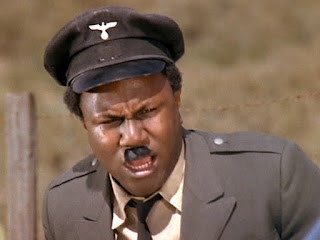
Also, a lot of the humor that was hysterical then is kinda rubbing against the PC model, with some gay and racial humor (e.g., a Black man in disguise dressed as Hitler), and a rape joke and assumption that it is women’s duty to sleep with someone to get what she needs for her job (in this case, a reporter). One could also see a bit of sexism if they wanted in a love song that professes, “Our love will be classy / Just like Timmy and Lassie,” but I’ll leave that one up to you to decide.

There are a number of song set pieces in here making it a musical-Lite , such as a salesman explaining to a government official about how he knows how to sway an audience (a pre-Wag the Dog influence, decades before that 1997 release?), or an Army officer doing an Elvis-ish song and dance with a chorus of soldiers that’s a cross between a Monty Python bit (“Oooh, get her / You military fairy!”) and a foretelling of Mel Brooks’ dancing and singing Merry Men in Robin Hood: Men in Tights(1993). Another spoof song that shows up occasionally is “Puberty Love,” done in a high-pitched whine by Matt Cameron, who went on to become the drummer for Soundgarden and Pearl Jam. With all that, the song that most people remember is the title one written by the director, sung in a bravado voice and whose chorus is incredibly catchy.

Sharon Taylor
As for the story proper, well, it’s a bit all over the map, but the closest thing to a protagonist is a government agent named Mason Dixon (David Miller). His not-so-bright sidekick is pilot Wilber Finletter (Rock Peace, aka J. Stephen Peace, aka the co-writer of the film) who always has his parachute trailing behind him. The government is trying to either keep the killer tomatoes a secret, or to convince the public that there is no danger, whose drive is led by Press Secretary George Wilson (Jim Richardson). However, news reporter Lois Fairchild (the willowy and unconventional cutie Sharon Taylor who has a Julie Hagerty vibe), is hot... on the trail of the story. Meanwhile, someone is trying to assassinate Dixon, while the huge tomatoes are gobbling people up.

Many of the people in the film went on to other roles, though few had spectacular film careers beyond the sequels, arguably other than “Twin Peaks” actor Dana Ashbrook, who had a non-credit role here. That is not to say there aren’t a couple of cameos here and there, such as English actor Eric Christmas (you’d probably recognize him if you saw him; d. 2000), and especially Jack Riley (d. 2016), a comic performer who had many roles in the 1970s and ‘80s, but is probably best known in the recurring psychiatric patient role of Mr. Carlin on “The Bob Newhart Show.”

There are two discs on this set, one in Blu-ray and one DVD, so you can watch it in any contraption. I don’t have an HD teevee, so I couldn’t tell the difference, but both have the same extras, which include the following:

Jack Riley
Of course, there is a commentary track, with the three original creators of the film, De Bello, Peace and Costa Dillon. They still work well together to tell the story of the making of the film through inception to anecdotes, all with a sense of humor without stepping all over each other, which is great. Even though it was recorded a quarter of a century after the film was made but a decade before this version of the release for the DVD in 2003 for the DVD release, as was the rest of bonus material, it still sounds relevant.

You may not know that the film actually started as a 17:35-minute short in 1976, which is presented here both without and with commentary track. It’s worth the view (for both) to see just how many of the gags they kept intact – if not nearly identical – and the storylines that were added to pad it out to a feature. It’s still pretty funny, shot as a college course student film on 8mm. The acting is horrendous, but it’s important to remember the context of when and why it was made. Also showing is an even earlier 32:27 short, “Gone with the Babusaland” from 1971. Being a silent film, it just comes with the commentary. It doesn’t really make too much sense, and it is funny in parts, but what makes this most interesting is it presents the early version of the Mason Dixon and Finletter characters that were incorporated into the main feature later. Unfortunately, the volume of the commentary is much lower than the others, so it’s a bit hard to hear.

The 14:14 short “Attack of the Killer Tomatoes: The Legacy” follows. This is a really fun documentary/interview with the three main behind-the-scenes guys, and pieces with people like Bruce Vilanch and other fans. For 3:40 there’s “Attack of the Killer Tomatoes Redux: Chopper Crash” which is about, well, duh. It’s an enjoyable mixture of news and archival material mixed with 2003 follow-up interviews with the crew and Jack Riley. The subsequent short is three “Deleted Scenes” that are enjoyable to watch, but yeah, they were right to be pulled as there was plenty of other gags that worked better that remained. The very short – err – short, “Famous Fowl,” comes after that at a mere 2:21 about the San Diego Chicken mascot discussing his being in the penultimate scene, shot in the San Diego stadium.

Next up is a 4:33 short titled “A Killer Tomato Invades Hollywood” (also called “Killer Tommatomania”). We meet “as seen on television” interviewer Wendy Wilder (I haveno idea who is she is, FYI) talking to some effervescent dude dressed as a “killer tomato guy” (described as “desperate actor”). He walks around Hollywood asking people (in an obnoxious way) to complete the sentence, “Attack of the Killer ____.” It’s more goofy than interesting. What I found more appealing (and humorous) is the 2:52 “Where Are They Now?” which catches us up with the main actors (as of 10 years ago, of course), narrated with funny dialogue. “We Told You So!” is a 3:07 look at how ahead of the game the film was in warning the world about GMO “Frankenfoods,” told in a humorously told-you-so snarky manner.

Rock Peace and David Miller
As for trailers, we get the theatrical one (see below), two radio spots, and oddly enough, the coming attraction for the Lech Kowalski punk film, D.O.A.: Rite of Passage.

The last presented is a series of clips of the songs, with the lyrics underneath (and a follow-along bouncing tomato ball, natch), and then “Slated for Success: The Killer Tomato Slate Girl,” with a 1:57 tongue-in-cheek honor for Beth Reno (who was also the production accountant), the film’s “Slate Girl.” It shows just how wonderfully silly this whole film is, in the long run.

There is a reason why AotKT has reached such a strong cult status, in my opinion. While not as noteworthy a bad film as The Room (2003), it’s come to be a funny mess that is worth the watch for the nostalgia, the mostly decent corny jokes, the political humor, and a snapshot of comedy of its period. It’s also interesting, as I’ve implied, to see it in a rear view mirror (as Marshall McLuhan would have put it), to note how the use of humor is reflected and arguably copied in more infamous films to come.


Review: Slaughter Drive

$
0
0

Text © Richard Gary / FFanzeen, 2018
Images from the Internet

Slaughter Drive
Written and directed by Ben Dietels
BPO Films / Armand Productions / Sub Rosa Cinema
101 minutes / 2017

Before I start, I seriously want to make one thing clear: this is a fun film that has issues, but I’m sure if you watched it, and especially if you are experienced in micro-budget horror, there’s a good chance you’ll come away with a smile. Please keep that in mind.

Within the film framework, Doug, Robbie and Gene (director Ben Dietels, Blake O’Donnell and Ryan Litner, respectively) are best friends. And as many best friends do, they tend to take each other for granted in insulting ways. I know I’ve done that with my besties. In the real world, these three actual friends got together and created a movie.

Ben, Ryan and Blake
There is no doubt where their hearts lie, right from the opening credits, which are in 1980s’ day-glo style and cheesy synth-based soundtrack; you know, where the music is couple of minor keys played over and over in fast sequence to express tension.

If you’ve ever seen films by Steve Rudzinski (and you should), the faces will seem very familiar, especially Rudzinski’s, who plays a television reporter cameo. Of course that means that this was shot around the Pittsburgh area (e.g., Moon Park)… but wait… this is a slasher film… in Pittsburgh? A film shot near Pittsburgh that isn’t zombie-related? Is that a thing?! Okay, yes, I kid. But it’s important to also remember that this slasher is also a fairly broad comedy.

After the inevitable and well played prologue, we are introduced to Doug, our hapless hero who is an independent... wait for it… filmmaker. Life is tough for him at this juncture as his life falls apart, which we are informed through a montage involving his unfaithful ex, Gina (Nikki Nader). With her, like most of the cast, it’s hard to avoid all the tattoos (not a complaint, just an observation). Luckily for most viewers, I am assuming, she also supplies some ample and well-appreciated skin.

Like Doug, his two friends are also nerdy goofballs, who are married with kids (we don’t see either of their families, though). Despite that, they all hang out regularly to play video games in basements, mock each other, and generally make asses of themselves to just about, well, everyone. Of course, that makes them quite endearing to us nerdy types. What I especially appreciate is that these guys don’t look like models, but are everymen who plays videogames in basements and watches micro-budget horror films. I also appreciate that the story doesn’t try to imply these guys are in their early ‘20s.

We also meet Doug’s creepy neighbors, MC Pink… I’m sorry, I mean Doug Flowers (Seth Gontkovic) and his cute wife, Diane (Nikki Howell, who I’m assuming is no relation to Thurston and Lovey). It’s no secret there’s something up with them, and for once, no red herrings.

People are being gruesomely butchered in the neighborhood and especially the local park (SFX beautifully handled by Cody Ruch). Filming some incidental material in said park, Doug accidently videos some nefarious action by a dark-clad figure wearing a bandana over his lower face, who is no surprise due to body shape and close-up of the eyes. But all things considered, such as the direction of the film, it’s all good.

Ben Dietels and Nikki Nader
Needless to say, the killer knows who our luckless trio of friends are, and is prepared to take action. And this is where the fun especially kicks in at full throttle (though at go-kart level, not NASCAR… which I joyously prefer, I might add). Our dweeby pals plot and scheme a way to get the bad guy before he gets them; whether they are successful or not – and things don’t always turn out as planned – well, I’m not going to tell.

Because Dietels, Litner and O’Donnell also co-produced the film, even though Dietels is credited with writing the film, most of the dialogue feels like it was ad-libbed at the moment. This usually works for them, as they really know each other well enough to play off the others, but sometimes it comes off as just plain goofy.

There are lots of indications they’re using their own houses, such as posters on the walls for previous Dietels films (e.g., 2012’s Captain Slickpants, which shows up in two different locations). Then again, the cast is part of an artist collective of filmmakers from the area, which also tells a lot about how they are all connected.

Yeah, there are lots of plot holes that you can fly a plane through, but it’s easily forgivable if one keeps in mind that this is essentially backyard amateurish filmmaking, but the reason it works is because of the heart behind it. You know these guys were having fun doing this, and it shows. It’s kinda like when you hear a demo tape of someone that was recorded on a cassette in a living room. Sure, a studio taping could give more texture, but the heart behind it makes the demo that much more interesting.

The acting is nothing that one can take very seriously. I mean, no one here is going to win any prestigious awards for their performances (e.g., Dietels acts a lot by rolling his eyes, O’Donnell tends to giggle, and Litner often looks like he’s exasperated). But again, there is a charm that lifts this to a different plane than some “serious” piece of art/filmmaking. It’s like watching a minor league baseball game: sure, it’s not the level of the majors, but that doesn’t mean to say it’s not going to be a good game.

For me, though, I believe this could have been edited down by at least 20 minutes. There are too many redundant scenes, such as one near the beginning with Dietels on his skateboard, or another towards the end where Robbie is driving his vehicle, and the camera comes back to him peering around numerous times; to be fair, there is a funny joke at the end of it, but it could have been handled quicker. Watching the guys josh with each other may build some background to the style of the friendship, but we get that pretty quickly, and some of that could have been in the “Deleted Scenes” when/if it hits the DVD market. And on another note, do we really need to see Doug woof his cookies three times? But don’t let that change your mind about seeing the film, because it’s not a key focus, it’s just yucky, and not in a good way (i.e., the SFX is good yucky).

Which leads me to something I really enjoyed about the film: even though the ending is a blast and totally unrealistic, it shows that despite the insults and behaviour between them, their friendship is quite deep and they will help a bro no matter what. As not all of them come out unscathed by the final act, the film actually does a nice job with showing the PTSD that most films ignore, after having been through such traumatic encounters. And still manage to do it with humor.

Yeah, this is silly, unrealistic, has holes, a bit too long, and the acting isn’t near superb, and yet I’m going to recommended it, again, to the kind of audience who can appreciate micro-budget horror with a big heart.


Review: Black Eagle

$
0
0

Text © Richard Gary / FFanzeen, 2018
Images from the Internet


Black Eagle
Directed by Eric Carson
Imperial Entertainment / Moonstone Entertainment / MVD Rewind Collection
104 minutes / 1988/2018

When this film was released in 1988, Jean-Claude Van Damme was not the star of it, even if he presumed he was; he was just 28 and not yet well known. The headliner was Japanese martial arts action film star Shô Kosugi, who had been a big draw for a decade, helping create the then-popular Ninja genre.

Let me say upfront that there are two different versions of this film, both available on the disc, which are the 93-minute theatrical cut, and the “Extended” 104-minute version. I went for the latter (sorry, but I’m not watching both right now to compare the 11 minute difference… perhaps some other time).

Jean-Claude Van Damme, Sho Kosugi
The plot is pretty bare-boned, but that was quite common in the action genre in the mass market days of the late 1980s. The basic plot thread is that a US classified plane called an F-111 Aardvark (a real, medium-range interdictor and tactical strike aircraft) has gone down into the Mediterranean near the Republic of Malta, and both the Americans and Russians are trying to find it first. On the US (i.e., “good guys”) there’s Ken Tani (Kosugi), and for the Rooskies, there’s Andrei (Van Damme, or JCVD, as he’s oft called in his publicity).

There’s a lot of saywhat moments (now known as WTF, but I’ll keep with the period) in stuff that’s glossed over in the film. For example, in researching Tani, the Russians are able to find him on their computers while at sea, long before Wi-Fi. This is Jules Verne type precognition. The server they use is quite antique even then (it has reel-to-reel memory). But, as Tani tells his young sons, in relating the family’s Black Eagle legend “You have to make it make sense to yourself.” I’m okay with that.

One consistency is that the two leads are kinda hard to understand (especially Kosugi when he shouts), between the Japanese and the Russian-cum-Belgian accents. The best accent is by the head of the Soviet team, Vladimir Kilmenko, who is actually Russian (Vladimir Skomarowsky). Then again, JCVD doesn’t even speak until 20 minutes in, and then it’s just sparingly, I am grateful to say.

The whole point of this type of film is (duh) the action, so oft times the plot revolves around the daring-dos, rather than the other way around. For example, there is the obligatory car chase around the narrow streets of the blazing white and grey Malta. As the cars go speeding by, people on the street don’t even turn around (unless they’re doing an action into the camera in close-up). That leads me to some questions, such as: was most of the action sped up with folly-added car screeches added later, is it that no one there gives a damn, or is this kind of thing so common that it isn’t worth noting? People are walking down the street with shopping bags talking as cars supposedly go barrelling by. It’s quite amusing.

JCVD, Vladimir Skomarowsky, Dorota Puzio
There are lots “action star” activities, such as hang gliding, wall scaling, running after (and away from) people, zip lines, and many fisticuffs. Most skirmishes are quick, but that’s because the real meat of the matter is Kosugi vs. JCVD. An interesting note is that this is late in the career of Kosugi, but early enough in JCVD’s that it doesn’t necessarily mean JCVD is going to win (hey, he’s playing a Russian, do the math). It’s similar to when uber-religious right-wingnut Chuck Norris went against Bruce Lee in Way of the Dragon (aka Return of the Dragon, 1972). However, it’s worth noting how it happens in a way that saves Belgian face.

As I said, the whole point is the final confrontation, but there are actually three meetings between Kosugi and JCVD, each one more intense, though all manage to throw in the “split” that would become JCVD’s trademark (much as Steven Seagal’s breaking arms). Both actors are good at it, there is no doubt about that, but they definitely have a different style, which kind of works for the action, i.e., Kosugi is loose (Asian style) and JCVD is stiff (like today’s Western MMA athletes). I do find it also culturally interesting that at the time Kosugi was the bigger star, but being Asian, even though he is the lead actor, his picture is smaller on the cover than JCVD.

As far as acting goes? Well JCVD comes across as stoically intense (most of his dialog consists of him saying different variations of “Go get them/him!”), neither are really great actors (though excel in stunts). The best actor of the bunch by far is Bruce French, a spy who became a Catholic priest, and who is the de facto sidekick to Kosugi. Being of the clergy, he doesn’t get “the girl,” but both of the leads do just that. For Tani, it’s blonde and big haired American spy Patricia Parker (Doran Clark); for Andrei, it’s the surprisingly sympathetic Natasha (Dorota Puzio).

Doran Clark
Keeping in mind the time period that this was released, it is interesting to see that there is quite a bit of gender politics on various levels. The most obvious is the high testosterone level that was present in nearly all these film. The two female leads (and I only counted three recurring speaking roles in the whole film) are kind of subservient to the males. Parker is basically a high-level CIA agent who mostly babysits and shows off her limbs and hair, and Natasha is totally ignored by Andrei (though he shows affection near the end, beyond the sex). At one point, some ugly dude body shames the very attractive Parker with “Too skinny.”

It’s also worth noting that the two youngsters playing Kosugi’s sons are, well, Kosugi’s real kids, Kane and Shane Kosugi (yes, their real names rhyme). The just-teen Kane gets to show off some nice moves himself (note that he is now a dashing martial arts actor in his own right).

The image of the film is quite clear, something the VHS copies I’m sure lack. This helps make the travelogue-ness of the beautiful Malta scenery stand out quite nice. The music tends to be a mild variation of synth-based, but not as gawd-awful as so much of the 1980’s… nearly everything.

This package has both a version in Blu-ray and DVD, which have the same extras. Beyond the chapter and sound variations, there are a series of short documentaries from 2017. First is the 21:23 “Shô Kosugi: Martial Arts Legend.” It’s a talking head monolog by Shô talking about how he grew up, got involved in martial arts, and became an actor. Nearly half of it is an interview with his now-adult younger son, Shane, who describes his own career and growing up with a famous dad. Did I mention that there is a very strong self-promotion bit for Shô’s book on Eastern Philosophy which borders on infomercial?

After that is a 35:43-minute “The Making of Black Eagle,” which is filmed 30 years after the fact. It opens up with the director, Eric Karson, which is mostly interviews with a whole group of people (one-by-one) including Eric, Shô, Shane, the screenwriter Michael Gonzales, and the two female leads, Patricia and Dorota. It’s interesting, discussing the likes of the relationships with all the actors (including the “pissing contest” between Shô and JCVD) and working with Shô’s accent. It’s keeps the viewers’ attention, though it’s a bit long. One person missing is JCVD. However, he is the focus of the next 19:20-minute “Takes of Jean-Clause Van Damme.” He is known for being both charming and (allegedly) a bit of a dick to other actors and especially women (he’s bi-polar), so I was curious to see this one. It’s also mostly interviews, but of course, JCVD isn’t in it. You get to hear all different aspects of his personality, and how the character of Andrei was essentially created for him, even though it’s so early in his career.

Bruce Friench
As for the 27:21 “The Script and the Screenwriters,” mostly dealing with Gonzales and some of Karson, and well, to be honest, I’ve burned out on how many documentaries I’m willing to watch on this film, considering there are no ghosts, no monsters, no chainsaws, no masked murderers, and absolutely no separated body parts. I quickly scanned through it. The last extra is the 11:16 “Deleted Scenes.” Most of these are already incorporated into the longer version of the film, so it’s nice to know what was added. Oh, I almost forgot that it comes with a film poster folded into the clamshell.

Will the good guys win? Will the bad guys get the transponder back to Odessa? Okay, what do you think? Point is, as I said, it’s the action that more important than the story proper. In that way, this film is a success beyond the acting and writing. And it kept a smile on my face throughout.


Review: Surge of Power: Revenge of the Sequel

$
0
0

Text © Richard Gary / FFanzeen, 2018
Images from the Internet


Surge of Power: Revenge of the Sequel
Directed by Antonio Lexerot
Lexerot Enterprises / Surge of Power Enterprises LLC /
Indie Rights Movies / Salty Horror Productions
90 minutes, 2016 / 2018

Surge of Power (Surge for short) may not be the first gay comic-style superhero, but he is quite possibly “cinema’sfirst gay superhero” (emphasis mine), as the publicity for the live-action film proudly states. The original was the 2004 release, Surge of Power: The Stuff of Heroes, but there is a 17-episode television show, “Surge of Power: Big City Chronicles” either out (no pun intended) or in process, which is also a talk/interview show; shades of 1993-2008’s “Space Ghost: Coast to Coast!”

Getting back to Surge and crew, I have to be candid and say that I have seen neither the original film, nor the television show, so I’m going at this as a stand-alone. Also I am approaching SoP as an Ally straight white male. There, now that the formalities are out of the way…

Most superhero films these days are not just multi-million-dollar extravaganzas, they are big; much bigger than they need to be to be interesting, actually, in my opinion. Be it Marvel (X-Men, Black Panther, etc.) or DC (Wonder Woman, Batman vs. Superman, to name just a couple), they go on for hours and have multiple plot-lines; Panther, for example, had at least three stories in it that would have made that many decent films, rather than three-in-one abbreviated tales, as is the trend. The digital SFX are so huge, that the stories lose the humanity in them through the chase for the WOW factor. This is why I don’t see many of them anymore, though I still consider myself a comic geek.

Vincent J. Roth
In this much smaller-scale indie film that thinks big, Gavin Lucas (co-writer, Vincent J. Roth) is the alias of Surge, who can focus energy, living in Big City, California. His adventures in the first film, to get us newbies up to speed, is expositioned (yes I know that’s not really a word) in abbreviated – and animated – form during the opening credits. Basically, through a Flash-like accident, super powers show up in Gavin and his co-worker (and ex-lover) Hector Harris, who becomes the Magneto-like Metal Master (John Venturini, another of the film’s co-writers). Also like Magneto, MM is Jewish (indicated at first by seeing him sitting alone at a bar, spinning a dreidel). The first part of the film feels like it’s his story, more than about Surge.

Stripped of his powers (in the first film) and recently out of prison, MM is turned away by his parents (played by Linda Blair and Gil “Buck Rogers” Girard), who are more disturbed about him being gay than a master criminal. The Jew is me balked at these seemingly non-Orthodox (but religious) Jews reacting that way; religious-niks, I can somewhat understand, though I am repulsed by homophobia by any religious group, though especially my own. Spurned and angry, MM is looking for a way to get back in the Evil game, and a Magical being named Augur (Eric Roberts) has an evil plan – and agenda – to help MM out in that direction. After the first 20 minutes or so, the focus is back on our Christian hero, Surge.

I won’t go into the story too much, I promise. The action does take us from California to Las Vegas and the Hoover Dam in search of a mysterious crystal called Celinedionium (if you don’t get it, say it out loud), drag queens, and a possible new love for Surge-io. In case you haven’t gotten this yet, it’s all very campy and silly, and abundantly enjoyable fun.
  
Gil Gerard and Linda Blair
The humor is broad (oxymoron pun intended this time), with a near-constant stream of jokes and ohhh-yeah references. Some of it is a bit subtle, such as many in the cast reading the book Zen and the Art of Super Vehicle Maintenance, or the knowing looks some characters give the audience directly by looking at the camera.

There is a lot of blatant and subtle (there’s that word again) references by characters of the Marvel, DC, Transformer, Roddenberry and LucasFilms universes. Part of how they get away with this is whenever there is a newscast, the scroll underneath the conversations that usually contains other news stories is actually an announcement that recognizes the copyrights of Disney, LucasFilms, etc. If you’re a comic nerd, there are multiple bells and whistles that will make you smile.

John Venturini and Eric Roberts
The acting is quite decent (though Roberts does his best John Lithgow sit-com level purposeful over-acting), and the tone is way more chill than most superhero films of these days. Rather than angst-filled heroes who are fighting their own demons as well as foes, other than MM and his parents, the deepest worry is whether Surge will find a romantic interlude. Other than cameos (which I will discuss shortly) there is a high level of gay characters that the odd straight one seems out of place, which is smile-worthy. I don’t seem to recall any lesbians though… perhaps in the next film? What can I say; I’m an Ally to all.

Nichelle Nichols
What really makes this film sparkle is the sheer multitude of cameos, which are Legion. The obvious ones are Blair, Girard, etc., but the others come and go really fast. In full James Balsamo mode, the crew went to conventions and got some great names that way, but there are just too many to mention all, such as the last appearances of television’s Jimmy Olson and Lois Lane, namely Jack Larson (d. 2015) and Noel Neill (d. 2016) from “Adventures of Superman” (1952-58). Some are listed in the trailer below, but there are so many others, like (and this is such a partial, factional list) various Power Rangers, Walter Koenig, Michael Gray of TV’s “Shazam!” (1974-76), Cathy Garver (a voice in many television Marvel superhero cartoons, and was also Cissy in “Family Affair” [1966-71] for my generation), and… Jeez, 

Mariann Gavelo
I could just go into IMDB and spend hours looking everyone up, it’s quite stunning. Often, there is some hint of the association, such as Rebecca Holden standing with the original K.I.T.T. It’s enjoyable to view just for this alone, but the story is equally watchable.

Unlike most of the superhero films being released these days, this one doesn’t take itself too seriously, and the better for it. And, as a straight white male, there is something for me, too, in the form of the relatively ironically named Mariann Gayelo. And then there’s also Dawn Wells. ‘Nuff said.

Meanwhile, I’m hoping a third film will come soon, and it won’t take more than 10 years.


Review: The Monster and the Ape

$
0
0
ext and live photos © Richard Gary / Indie Horror Films, 2018
Film images from the Internet


The Monster and the Ape
Directed by Howard Bretherton
Cheezy Flicks / MVD Visual
450 minutes, 1945 / 2010
www.Cheezyflicks.com
www.MVDvisual.com


Serials came and went along with the cinema stage shows, and eventually double features. But in 1946, when these 15 installments were released to an post-war audience, still reeling from the scare of spies and the technology of an emergent atomic age, it was expected, along with the newsreels. The timing of these serials in it's cultural context is worth noting.

Howard Bretherton had a long history of directing B-films, mostly westerns, but he definitely moves into the industrial spy / sci-fi / horror genre without missing a mark, since they end up being pretty much the same: central villain, his henchmen bad guys in black suits, the hero from out of town dressed in a lighter color (gray, rather than white), the pretty heroine, and her victim father. Add in the dizzy driver to replace the dizzy wagon train cook, a robot and gorilla (in place of the cows and horses. perhaps?), and there ya go. Bretherton would also direct a couple of episodes of The Adventures of Superman in 1958.

The plot is nonsensical, but so what, this isn’t supposed to be rocket science (pun intended), but rather a way to keep the audience coming back to the theater for a 30-minute episode over 15 weeks. The production cost is kept to a minimum, and it kept the cash rolling in. Those times as is now, it is not the average film that brings in an audience, but the schlock. People would rather see Friday the 13th Part XLI than just about anything with Judi Dench. Adam Sandler outsells Robert Dinero. People just like mindless entertainment. Fortunately, depending on the genre, I’m one of them (gabba gabba we accept you, one of us!).

The monster, in this story, is a robot (uncredited), and the ape is, well, a guy in a gorilla suit. Let me stop here a sec and comment on them. The robot (called a “rob’t” by one of the henchmen, and a “rabbit” by the good guy’s driver / servant / etc. – to the extent of commenting he wanted it to get back into its “hutch”). The ‘bot doesn’t move much through the series, though he is often carried by the bad guys. Six feet of metal, and they carry it like it’s the hollow shell that it actually is. When it moves, it makes exaggerated movements, making knee-high steps, and moving its arms up and down. And, of course, there is a buzzing, electrical sound whenever it is in motion. My guess it was really hard to move in the thing, and whoever was inside (when it wasn't being carried) did the best he could. Speaking of which, the ape, Thor, is played by an uncredited Ray “Crash” Corrigan (the box for this release wrongly identifies him as the robot), who did a spectacular job at both being a gorilla and stealing the scenes, grabbing at hats while people are talking, and generally being a nuisance to the actors, but a joy to the audience. My commendations. Corrigan would play apes in many other films, such as Nabonga, The Monster Maker, The White Gorilla, and Bela Lugosi Meets a Brooklyn Gorilla. He also made a bunch of westerns and classic D-grade films like The Zombies of Mora Tau and as the title creature in It! The Terror from Beyond Space (from which the plot of Alien was – er – inspired).

I also want to touch on the fight scenes, in which there are usually two per half hour episode. Most of the time, it’s our hero, Ken Morgan (Robert Lowery) against two or more of the thugs, with fedoras rarely leaving the heads while the punches fly, and certainly no bruising or other side effects from the action (except for a slight limp after a run-in with Thor). There seems to be a set series of types of fight moves: for example, there is the leap as one fighter jumps at the opponent, the wait as the puncher hesitates and gives a second for the punchee to either get up, or retrieve his hat, or brace himself for the next punch, and there is the play-through punch where the hand comes way back to the point of a question of balance, and then it is thrown. Then there are the moments when the punches actually miss (unintentionally), yet the person air-punched falls. These are my favorite ones, and I actually played a couple of them back in slo-mo. At one point, a villain hits our hero on the head with a gun, and then fights with him. Why would he not have shot him, other than needing him to be around for more episodes?

Logic and consistency is not something that is prevalent in serials, generally, which makes them all the more amusing to watch. They exist in their own world of physics. For example, in one episode a machine is discovered to find a metal called metalogen that is found in meteorites that have fallen (which is needed to make the robot run), but in another, all there is in the world is located at one spot under a car garage in the town where the story takes place, but then there is more, but then there isn’t… And if that’s all there is, how did they get the metalogen man (robot) to work in the first place, and why would a scientist somewhere else invent a machine to find the stuff is it’s only in one spot, and…well, you get the idea.

The basic premise is that four scientists invent the robot, but only one wants the claim, so he kills off two of them right away, and the third one he keeps around because that's the one who has the robot in his possession; apparently the only way to get it is through him. The ape is controlled (somewhat) by one of the henchmen, who is also a zookeeper, and is often brought to the villain’s home via a tunnel connected to Thor’s cage at the zoo.

The thugs kidnap just about everyone in the cast, at one point or another, and yet all of them either escape or are released by one of the other cast members just in time. Rarely, though, are the cops involved onscreen; usually, the main characters go to investigate by themselves (flashlight always at the ready), finding themselves in a pickle (or at least a fist-fight) of some sort. The one time a police inspector actually is around the bad guy’s house is near the end of one episode and is never seen again, nor is his disappearance explained.

The main theme of any serial is the cliffhanger at the end of each chapter. [Note: One spoiler alert in this paragraph.] It is so funny to see the end of the chapter, where it is clear that someone is injured or killed, e.g., a rock falls on one… well, a dummy dressed as him, at the end of one episode, but when you see the next chapter, he dives out of the way before the rock hits him.

There is a lot of use of then-new technology in this storyline, such as television signals and robotics, but it is not fully explored as a sociological phenomenon as much as “look at all the cool high-tech stuff we know about.” It would be like someone using Twitter a couple of years ago in a movie, but now would be looked on as everyday.

As I stated, the hero is played by Robert Lowery, who visits the Bainbridge Laboratory where the robot was created – as an investigator from a company who wants to mass market the creature to save us all from toil. He is straight-laced as they come, a handsome figure yet hardly romantic (never makes a move on the only female in the cast). He’s hardboiled, though, enough to make a grab for his hat before leaving a building about to explode; very noir detective-like in his demeanor. Lowery would have a long career, as would most of the cast, moving on to golden age television appearances from an episode of Superman to the likes of Playhouse 90. He was also a regular in the 1966 western series, Pistols ‘n’ Petticoats.

Ralph Morgan plays Professor Arnold, the lead scientist of the group who invent the robot. He is often found to be misled, though not confused, and makes many mistakes (thinking the hero is with the villains, giving up the robot to the wrong people, etc.). Morgan embodies him as intense, and yet he remains likeable despite all his mishandlings. With a career of character acting that dates back to the silent era, Morgan also had his share of roles in exploitation films, such as Night Monster, Hitler’s Madman, Weird Woman, The Monster Maker, and Black Market Babies.

His daughter-secretary, and seemly not love interest for Ken, is Babs, played with a soft Lauren Bacall feel by Carole Mathews. She is often whiney (“I’m so worried about my father!”), easily fooled, and most of the time very jovial (“Oh, that’s wonderful!”). She is definitely a post-war poster woman, wearing suits and working in the lab with her father, as well as assisting him. But she sees more physical action from Thor than Ken. Mathews would also go on to character acting on early television, though her last credit is dated 1978.

As the villain, Professor Ernst, George Macready had the most luck in television, even appearing regularly on the soap opera, Payton Place. His face is definitely recognizable to me for appearances on the likes of Get Smart, Night Gallery, and both County Yorga films, but in this serial, his evil Ernst comes across more as a Dr. Evil than a Blofeld. At one point one of his henchmen says, “This is your fault” after a scheme backfires, and he actually agrees!

However, the one person in the cast who achieved the most fame is the driver / servant, played in total “yah-suh” mode by Willie Best, the man who made the line “Feets don’t fail me now” famous (though he doesn’t say it here). He plays timid through the whole series, which makes watching a bit of a winching fest for the viewer. There is even a racial epitaph stated by his character about himself. From what I understand, Willie was a nice man, a total professional, and was aware of what he was portraying, publicly acknowledging that he did what he had to do to keep getting work (Paul Robeson had the same dilemma, though he was able to rise above it that’s to that voice). A drug conviction led to the end of Willie’s career, further heaped upon as a symbol of “Uncle Tom” during the ‘60s social revolution, which is a shame. To me, his character is actually the most human and likeable of the bunch, with the rest being a bit stiff in their character. Willie’s characterization of Flash gets to roll with the punches, and has the last word. I’m willing to bet much of his dialog is ad libbed, such as often referring to the robot as a “rabbit.” He is a wonderful comic relief.

Serials were from a specific period of time, and the whole pastiche of them had a quality of their own. They were quick and dirty, from writing to acting to filming (some scenes here are shot one camera for relatively long shots).

There are a many of ways to make it through the two discs of all 7-1/2 hours of film and the different extras (trailers, intermission clips) that are on both, including as a marathon, or watching one episode per night. Despite the occasional cringe-worthiness of the series, it is enjoyable, so grab some friends, a few bowls of popcorn, perhaps even some libation (coffee for me, please), and spool away.

This review was originally published in FFanzeen.blogspot.com


Review: Housesitters

$
0
0
Text © Richard Gary / Indie Horror Films, 2018
Images from the Internet


Housesitters
Directed by Jason Coffman
Tomorrow Romance
62 minutes, 2018
www.housesittersmovie.com

Man-oh-man-ohhhh-man! Though this is showing my hand way too early, what a fun ride. At just over an hour, this horror comedy that is partially shot on iPhone is short at just over an hour, but I happily watched it twice in a row.

In the story, some friends put a video out on the ‘Net that they are looking for a job as a housesitter (I know people who actually do this). Of course the house that comes their way is nice, has a platinum card for ordering food (and a lot of it)… and, oh yeah a Little Bastard of a demon’s familiar created by the horror puppet master himself, Dustin Wayde Mills.

Peter Ash, Jamie Jirak, Annie Watkins
At the core of the story are two friends, Angie (Annie Watkins) and Izzy (Jamie Jirak), who riff off each other so well that the actors playing them get a writing credit, and rightfully so. While the situation is supernatural and their reactions are hardly what would happen in the real world, the pace and toneof their comments feels like these guys actually are friends (I have no idea what their relationship is beyond the camera, of course).

This is a first feature (relatively speaking, length-wise) film for Jason Coffman, and I certainly hope it’s not the last, especially if he keeps Jirak and Watkins in tow; the three of them certainly make a strong team. There’s lots of pot, mixed drinks, and porn (the latter is not shown, just discussed while viewed off camera… yes, by the women).

There’s a lot to unpack, including demon possession, a small body count, the undead, a house with boundaries, time travel, and a whole bunch of smart-assitude that had me laughing. Joining the women are Izzy’s kinda lame boyfriend, Zach (Peter Ash), even though he is the most clear-headed of the group as far as the situation goes, Angie’s crush Mark (Ben Schlotfelt), and Zach’s annoying pal Dan (Jay J. Bidwell, who’s had one of the more extensive credits of a mostly newbie cast).

The film is presented in two parts of “Invocation of the Demon God,” as “Episode 7” and “Episode 8.” I have no idea what that means, but I know I want to see more. It’s separated by an animated short that…well, you have to see it. That being said, I know the whole mandatory September 11, 1991 prologue is necessary to the story, but it didn’t really do much for me. Oh, if I may digress for a sec, but it seems to me the actor (Mariah Michael) is not a smoker, considering how she never drags, just draws and blows; in some ways, that sets the viewer up to the goofy level. Anyway, that may be, however, because of the high level of the rest of the film’s – err – story, thin as it is (and rightfully so).

Don’t get me wrong, this is silly-ass shit, and perhaps the reason there is so much cannabis inhalation is because they’re feigning to a stoner audience, but it didn’t have to be, in my opinion; it stands up on its own weirdness and attitude. The acting is a layer of goofy with a natural relationship between the women, and a bit of skewed feminism thrown in at a subtle level.

What makes me sad about this film, and I’m being serious about this, is that I wanted more. The ending is a bit up in the air and left me with some questions, but what I wanted was the story not to end because I was enjoying it so much.

Little Bastard
However, what I especially enjoyed about the story is that it takes you in a direction you are probably not expecting, and yet it’s comfortable with the world in which it takes place. For a horror film that is not based on body count, gore, or even a realistic-appearing killing creature (but Little Bastard does look cool), and yet also is steeped in silly dialogue and actions even for stoners, it feels somehow right in this context, and doesn’t overreach. An hour is the right length for this – even though I wanted more – without padding it out to fill the time with, say, people walking around with flashlights for minutes on end, or seeing spooks in the mirror (man, I’m tired of that cliché)¸or people in masks and sharp implements. It’s a bit of a different approach to an old theme, which is something one may not expect from a micro-budget broad comedy with horror elements. I’m grateful.

For those interested, the world premiere is at the Windy City Horrorama on April 28, 2018. As it was filmed in Chicago, it makes sense that the screening is at the Davis Theater.

This film is so much more fun than the 1992 Steve Martin-Goldie Hawn one with a similar-yet-singular name, and a fraction of the budget... but how did I miss the emu?


Review: The Unwilling

$
0
0
Text © Richard Gary / Indie Horror Films, 2018
Images from the Internet


The Unwilling
Directed by Jonathan Heap
Vision Films / Northern Prod / Rough Diamond Prod /
Bertone Visuals Prod / Corrales Digital /
84 minutes, 2016 / 2018
theunwilling.com/

When I see a film that has played many festivals and numerous and very different posters, I get a mixture of excited and cynically suspicious. But I’m keeping my fingers crossed. The director, Jonathan Heap, was nominated for an Oscar in 1991 for a short called 12:01 PM. Since the millennium, most of his work has been shorts and a television series. I willingly enter the bargain of watching this with hope, however, considering the cast and the look of the stills from it, but I’m jumping ahead.

The premise is simple: an ugly and evil box gives you want you want, and then takes over your body and either kills others or gets the body killed through its actions. For lack of a better term, I’ll call this being a demon, though it’s never really quite specific on its origins, and even complains when someone tries to name it.

We learn the box has been doing this for quite a while as we meet an extended family, based on the children of the previous “owner,” veteran badass Lance Henricksen, who in an extended cameo still manages to outshine most. After the box had come into his life when the now adults were mere kids, he had changed and became a cruel tormentor to his children, leading the main and locus character, David (co-writer with the director, David Lipper) to become housebound due to severe OCD (think of Monk with agoraphobia and without the humor).
                                                                                                                                
Lance Henricksen
Also joining him at his home after the death of his dear old evil dad, to hear the reading of the will, are his similarly abused and hyper-vain sister Michelle (Dina Meyer, who gets to show off some impressive yoga moves), her brutish ex-husband Rich (Robert Rusler) and his current fiancée Cheryl (the lovely Bree Williamson, who I remember from the underrated television show, “Haven”), and cousins Kelly (Austin Highsmith), who is a lawyer and enabler to her junkie brother, Darren (Jake Thomas).

Not a huge cast, but just enough for a decent body count. But I’m jumping ahead of myself again here. The box itself looks pretty cool, sort of like coal with a Cthulhu-similar raised octopus design on it. There’s no denying that it’s bound to remind one of the Book from Evil Dead. Fact of the matter is that there is a lot here that is reminiscent of other films, which in itself I don’t really find to be a bad thing most of the time. It’s like a game of “Oh, I know that one! Take a drink!”

Dina Meyer
The film has moments of slow pacing here and there, but mostly it’s a building story. That being said, it can definitely use some editing and excising, such as how many times do we need to see the water coming from Meyer’s shower head straight on? It’s almost like you’re stuck a bit in David’s need to (rinse and) repeat. Luckily, this doesn’t happen often enough to give up on the story, which mostly works pretty well, in part thanks to its seasoned cast (meant as experience, not age).

Many of the characters are either not likeable or a bit two-dimensional, though David’s seems to be the most thought through (well, the actor playing him didco-write it, remember); however, he is also the center of the story, so that makes sense. We don’t get to learn too much about the others; well, more than occupations and allegiances. There’s very little backstory other than bad dad.

My big question, though, is the title. To me, it sounds kind of contradictory. Okay, here is what I mean by that: the whole premise is based on all the characters volunteering to do something with the box that I won’t give away, and then the box giving each what they want in order to…well, you know (i.e., see the film for yourself). They make choices about what they want, and follow through with the devil’s deal (or demon’s; still not sure). That sounds more like willingthan unwilling. Is there something I missed? It’s a similar theme to the Leprechaun franchise where he grants wishes that brings along demise in it, or even as far back as Goethe’s Faust. The working title of the film was The Gathering, and while The Unwillingdefinitely sounds more chilling, the other seems more accurate. Yeah, I know this is a bit nit-picky; do with it what you will.

Bree Williamson
The SFX in the film are occasionally practical appliances (the blood consistency and color is really good, by the way), but there is also a lot of digital hoo-haa, such as swirling smoke, mirror tricks (reminiscent of Carpenter’s 1987 Prince of Darkness) and a visual “ripple” that leads a character to the box to get what he needs/wants. Other than one cheesy effect outside the house, they all look decent, but it’s pretty obvious that it’s optical.

The press release for the film quite proudly states (and rightfully so), that the crew includes the aforementioned Oscar-nominated director, “Oscar-… and Emmy-winning Cinematographer David Stump,” and multiple award-winning writer Philip Morton (second director and co-producer on this film). With all this heavy power, it’s not surprising that the film looks as good as it does. There is no one thing that is a standout to make me say “Wow,” but it’s definitely a good film, though somewhat washed out of color (I’m sure purposefully). Do I think it’s deserving of such praise? Well, it’s been shown at two dozen festivals around the world, so you there is something there worth noting.

Austin Highsmith
Other than editing, my only real note and quibble is that I think it didn’t go far enough. Except for a nice surprise at the end with an equally enjoyable practical effect (well, it looks like it is an appliance, so I’m assuming…), there is hardly any blood (even with the one person stabbed in a strategic place), the sensuality is minimal other than an affected nurse (Levy Tran, who is on the poster and most of her appearance in the film is in the trailer) and a seduction that changes tone, there is no nudity even with the obligatory shower scene (perhaps the Director’s Cut in a decade or two?), and a low level of actual scares. The pace and angst definitely increases over the course of the film, but it tends to get more shrill than thrill.

Jake Thomas
And yet… I still had a bit of fun watching it. Yeah, I’m critical, but I hope I am not harsh. Even with a seasoned director, actors and crew, there’s the next level and I mean these comments as “notes” and “critique” more than just “opinion” (i.e., where the problem are, rather than “good/bad”).

For example, the acting level is fine, with a bit over- and underacting on occasion. As I said, the cast are seasoned pros and have quite a catalog behind just about all of them, from both film and television, and it shows. The strongest weakness (an oxymoron!) in the writing comes, I believe, from this being the first screenplay for Lipper, and director Heap hasn’t had a writing credit since the early 1990s. But I hope they both continue to stretch their writing wings because there is promise here, and I think by a couple of more films they can be a force. I look forward to that.


Review: Caesar and Otto’s Summer Camp Massacre

$
0
0

Text © Richard Gary / FFanzeen, 2018
Images from the Internet


Caesar and Otto’s Summer Camp Massacre
Written and directed by Dave Campfield
Fourth Horizon Cinema
75 minutes, 2009

Okay, this is a bit ass backwards: I’ve seen the films that followed this one, such as Caesar and Otto’s Deadly Xmas (2012) and Caesar and Otto’s Paranormal Halloween (2015), but never the original Caesar and Otto (2007), nor this one. Well, one down and one to go.

I’ve been a fan of the CandO films for a while now, and they’ve gone through some metamorphosis / growth over time thanks in part to additional experience in writing and direction by Campfield, plus the actors becoming more comfortable with their roles.

Foreground Ari K. Garg, Dave Campterfield, Paul Chomicki
The focus is on the two Denovio half-brothers: the insanely controlling, uptight and sexually ambiguous Caesar (Campfield), and the older and slovenly Otto (Paul Chomicki), who is the polar opposite of Caesar in every way. They don’t usually get along very well, but they rely on each other in ways that go below the surface. Added to this formula is their horn-dog grifter father, Fred (Scott Aguilar), who is self-assured and suave in ways his sons both detest and admire. In all the films, Fred keeps popping up in the strangest places at just the right (or wrong) times.

I am hardly the first person to say this, but this series is often compared to the Stooges, but I have my own theory: they have the slapstick of the Stooges, the anger of Abbott and Costello, and a wit like the Marx Brothers… okay, there is only one Bros. Marx, but there is a sharpness here amid a certain sort of purposeful witlessness that elevates this to beyond slapstick… and believe me, there’s plenty of that, as well. If the viewer takes it on the surface, it’s a fun escape piece of cinema nonsense that’s good with beer and pizza. But if one is a genre fan and pays attention, there is a level beyond the obvious, full of references to other films – the later CandO ones, even more so; it’s a bit tad more subtle here – and the humor is nearly constant, which goes well with, well, beer and pizza… and a game of spot-the-allusion. Take a drink every time you connect to one, and you’ll be blitzed by the end.

Felissa Rose
On the run after a road rage incident (Caesar is a rag-aholic with boundary issues – but then again, what rage-aholic doesn’t? Am I right?), CandO hide out by becoming counselors at a sleepaway camp where nefarious things are afoot. It’s run by Jerry Griffen (CandO regular Ken MacFarlane, who always plays someone evil named Jerry and has a last name that starts with a “G”). Among the counselors is the moody and hyper-sensitive Dick (Deron Miller) and the mysterious Carrie (Regina ula italiana Felissa Rose, also a producer of this and other CandO films; she’s will be forever known for a role she did as a youth that includes one of the oddest and longest still frames in horror cinema, which is the basis for this film; oops, reference, so take a sip of that beer!).

So much of the cast here, in its nascent troupe form, is a group that would be recurring in many of those CandOs to come. For example, there’s Avi K. Garg as a fellow counselor who has a running gag through all the releases, self-titled (and rightfully so) Scream-Queen Queen Brinke Stevens who is a shady character that has latched onto Otto, and Joe Estevez (brother of Martin Sheen) as an kinda nusty authority figure who is a fictional version of himself. Also worth noting in hindsight is another counsellor, Trai Byers; he would go on to become a regular on the remake of “90210”(2012), and more recently “Empire” (2015-present).

Everyone in the camp has their own agenda, including murder, thievery and cowardice, all of whom often make their hands present, even if the viewer doesn’t always know whose those are… yet.

Add caption
As for the murderer, well, I figured out for surewho the killer is at 43 minutes in, but not the why until the reveal. And speaking of time, there is a great visual gag at 35:50 that made me laugh pretty hard, and re-played it a couple of times more before moving on. The head count is not extremely high, but it’s plentiful. Despite the budget and cheesy flavor of the whole she-bang, Richard G. Calderon’s make-up SFX is quite worthy of notice.

The acting is done a bit campy, especially Campfield’s ham-fisted Caesar character who is – ta da– a bad actor. In later films Campfield will tone down the pretentious line reading (again, purposeful). Chomicki’s Otto is like a big child, hopeful and innocent in a kind of girl-hungry way, fumbling into relationships; Chomicki plays him with glee. As for their roguish father, Aguilar just looks like he’s having so much fun. In fact, most of the cast seems to be enjoying themselves, and that transfers to the viewer nicely.

This film is a lead-in to two horror shorts, the 9:39 minute Caesar and Otto in the House of Dracula (2009; HERE)  and the 16:51 Caesar and Otto Meet Dracula’s Lawyer (2010; HERE), which features yet another famous actor’s sibling, Ed Dennehy (bro of Brian), who plays Steve Dracula (brother of… you know who). They’re completely shot on green screen and make an interesting experiment. Plus, look for the cameo of Pigzilla!
                                                        
If you’re in the mood for something deep, well, you’ve sorta come to the wrong place. I mean, there is a certain well of depth if you’re looking for it, but most people are going to see this merely as a fun way to spend an afternoon. Both ways are viable and I respect both approaches to looking at it; that being said, there is more to be gained by going beyond the surface, in my opinion.


Review: Pretty Fine Things

$
0
0

Text © Richard Gary / Indie Horror Films, 2018
Images from the Internet


Pretty Fine Things
Written, cinematography, directed and edited by Ryan Scott Weber
Weber Pictures Co. / Wild Eye Releasing / MVD Visual
100 minutes, 2016 / 2017
www.wildeyereleasing.com/

While sometimes made-up places can have decent names, or even just something like Smallville, but for me, I’m a fan of maps. I especially love when not only are real places used – especially rural ones – but also have great names like Bernardsville, New Jersey. Yep, that’s where this Podunk takes place. It’s only about 45 miles west of Hoboken, somewhere between Routes 78 and 80. I’ve passed the sign for Bernardsville many times on my way to either Pennsylvania or back to Brooklyn, though have never stopped off there. It’s also where this slasher release was shot.

Lynn Lowry
Outside this relatively small burg is where some of the fictional Banner family resides. Papa Banner (Ralph Cobert) is going blind and senile, missing his past-on wife (the always amazing Lynn Lowry, in essentially an extended cameo), who we see in flashbacks and dreams. They have three sons, and right off the bat we already know that the one who lives with dad, Walter (Brooklyn’s own Joe Parascand), is a bit off; I don’t think I’m giving much away as less than five minutes in he’s involved with dispatching Heather (the very cute Krista Robelle) after she has a fight with her boyfriend, Jay (Jesse Stier, whose face hair volume seems to changes from scene to scene).

Joe Parascand
After the prologue, we meet three late-20s-looking college students from Worchester, MA: the blonde virgin Hayden (Emelia Brawn) who gets constantly teased by her friends, Wendy the redhead (Lauren Renahan), and Ashley the Latina brunette (also cute Camila Perez). They rent a house from Walter to have a Halloween party. The many guests – aka, the body count – arrive, as do Walter’s two equally serial killing and mother-obsessed brothers, Thomas (Patrick Devaney) and James (Adam Ginsberg), who are they to create the body count. Their aim is to delete sinners from the world, and have women to “substitute” for mommy dearest to dear old senile and near blind dad.

Added to the mix are two police detectives investigating the recent string of missing women, Jake (director Weber) and his partner/love-interest Jennifer (Kristin Accardi), and their Captain (Christopher J. Murphy), who for some reason looks more Texan than Jerseyite, right down to the Stetson…and yet has a map of Italy on his wall (I’m sure it belongs to whosever space they were using).


Ryan Scott Weber
This is just the basic set up. As you can see, there are a lot of elements going on at the same time in this very ambitious screenplay. The story jumps around each of the three groups – the Banner family, the women/party, and the police – in quick order, circling around until they all collide together. While all of this is going on, we get to know a little back-story, which is welcomed and tends to be missing from most films, so thanks for that!

Being the modern world, most of these kinds of films that involve the slaughter of many (some men, mostly women), you know there has to be a twist, and is partially indicated early on when one of the women comments on the weirdness of Walter, and the response from another is, “We are a little creepy, ourselves.” While this is more than just a subtle reference to a line from The Craft, it is potentially a good thing. But also like contemporary horror cinema, especially indie releases, the action takes quite a while to start. There is some minor bloodletting to whet the appetite, but the real action kicks in after the expository about an hour in, when the Halloween party begins.

Camila Perez
Which brings us to the gore: we don’t see much in the first hour, even with some killings, but when the party starts is when it really kicks off. Michael Anthony Scardillo does a bang-up job with it, nearly all appliance SFX, when we see it. What I mean is that a lot of the violence to bodies is done through clothing, such as stabbings, but every once in a while, we get to see some viscera and bloodletting, and it looks really good. As for nudity? Well, we get to see a lot of cleavage and bras, but no naughty bits, even with a shower scene (still in underwear). Well, the cast is attractive, so I’ll move on after the following comment: there are a lot of tattoos on nearly everybody, including at least one full chest-plate. “Ouchies!”

The weak sides of the film are as follows: there really needs to be some editing done to bring this puppy down to at most 90 minutes. There are definitely superfluous moments that could be done away with without losing any of the story (I’ll get to the actual “Deleted Scenes” extra in a mo). Most of the acting is quite decent, such as by Parascand who steals nearly every scene he is in (his close-mouth smile is just the right level of eerie), and Perez is a close second, though there are some characters that are pretty wooden and only there for the body count (in the party scene, so it’s actually a positive, right?). Lastly, the writing is a bit shaky in sporadic parts, though I will say there is a nice and subtle humor that shows up throughout here and there, especially with the coppers, to balance it all out.

Lauren Renahan and  Emieia Brawn
On the positive, I was mucho grande impressed that there were at least three unexpected twists in the last 20 minutes, which I’m not going to hint at in any way. There is also an interesting use of color tinting throughout, which isn’t as subtle as it could have been, but still works. The camerawork is also quite good, using unusual angles and through objects in a way that doesn’t come across as all artsy, but still stands out.

The extras include a 10:05 blooper reel that was okay, but did not really bring anything major to the cast to indicate friendship or amusement to the viewer (well, this one anyway). The three female leads are friends in real life, but you don’t really get that here. But blooper reels tendto be overrated, in my opinion. Next is a 27:28 “Behind the Scenes” collection that is narrated by Jay Kay, host of “The Horror Happens Radio Show.” Rather than just watching shots being set up (which I find boring), Kay wisely interviews the seven key players, and some of the production crew. It’s a bit long, but most of it is interesting. The cheesy music behind it gets to be a bit much, but I think I’m nit-picking there.

This is followed by a 9:44 “Deleted Scenes” which also includes some extended ones, and an interesting alternative ending. In all, I feel like they made the right choice to put these here, rather than leave them in the film. Still, it was good to see these after watching the film. Of course, being a Wild Eye Releasing – err – release, there are a half-dozen trailers for other indies, mostly with a theme that I won’t say as it sheds a light on a spoiler alert. I really like Wild Eye’s stuff.

The main extra, which comes first but I saved for last (in both review and participating in) is the full-length commentary. Thankfully, it’s only Weber and Parascand so there is hardly any talking over or bravado, just stories about filming, both about the ideas behind it and anecdotes about the shoot, and it’s an easy listen that doesn’t get boring.

This is essentially a story about playing with the perception of who is “good” and who is “bad.” You can tell this is an mico-budgeter, but Weber does a great job in showing what can be done with very little, and make it look big.


Review: Twilight People

$
0
0

Text © Richard Gary / Indie Horror Films, 2018
Images from the Internet


Twilight People
Directed by Eddie Romero
VCI Entertainment / MVD Visual
81 minutes, 1972 / 2018

I have two converging thoughts about this release in a general way, before I get into specifics. The first is that I remember in the early-to-mid-1970s when there was a host of Philippines-shot films that were showing up in the theaters, though I was too young at the time to realize they were mostly directed by the same guy, Eddie Romero, including Women in Chains (1973, also known as Black Mama, White Mama). Most of his output at that time were about people being held against their will (either convicts or kidnap victims), and them being tortured and/or turned into some kind of monster, such as animal or zombie.

My second thought is about handsome actor John Ashley. He started out mostly in shirtless in a bunch of beach and gangster films in the early 1960s, and ended up making numerous horror films… wait for it… in the Philippines. And yes, for Eddie Romero, such as Mad Doctor of Blood Island (1968), Beast of Blood (1970), Beast of the Yellow Night (1971; I remember cutting out of school to go see it), and this one, each directed by, yep, Eddie Romero. These even helped create a sub-genre called the Blood Island Films.

Now, while these films get accolades now, and Romero has won lots of awards (especially from the Philippines), the truth of the matter is most from this period and genre are cheesy messes; but the good side of the coin is that is also part of what makes them such a joy to watch. It is one solid WTF moment after another, be it story, make-up effects, acting, and so on. But I’ll get more into detail as I go along.

Sporting Tom Jones-level sideburns, soldier of fortune, adventurer and man-about-town Matt Farrell (Ashley; d. 1997) – who is repeatedly called by his last name throughout – is kidnapped while SCUBA diving by blond Robert-Shaw-in-From Russia With Love-wannabe Steinman (Jan Merlin, who perennially played bad guys, especially in Westerns) and the luscious but icy looking brunette Neva (Pat Woodell, who played Bobby Jo in “Petticoat Junction”; d. 2015). The man behind the plot is Dr. Gordon (Charles Macaulay, better known as Landru to “Star Trek” fans, and Dracula in Blacula; d. 1991).

Okay, so now that is out of the way, Farrell is brought to Dr. Gordon’s island fortress (where did he get the money?), to which Farrell presciently asks, “What is this circus?” It’s a good question because the gooddoctor wants to help science and humanity by combining humans with animals. If it sounds like HG Well’s The Island of Dr. Moreau (enjoyable book, by the way), you wouldn’t be the first to agree, and I would not either; hell it says it right on the back cover of this edition. But to add to the mix, I would say it also seems to rely some on 1958’s She Demons, also set on an island with a doctor playing havoc with the human form (mostly female, of course).

Pat Woodell and Pam Grier
Unlike those other two, however, this film really can’t seem to make up its mind to its genre, exactly. Okay, it is a horror, especially the Mad Scientist type, but at some point it’s a war film and a bit of a Western. There’s also some humor thrown in here and there, but I’m not sure if it’s intentional or not; either way, I’ll take it. And enjoy it.

Most of the humor lies in the transformed creatures, including a panther woman (an early role for the great Pam Grier), an ape man (Kim Ramos), a real bat man who steals his scenes (Tony Gosalvez), and a surprisingly touching romance between an antelope man (Ken Metcalfe) and wolf woman (Mona Morena). Oh did I mention that these two aren’t the only romance that develops in the plot? Of course, in a post-James Bond world it will come as no surprise. Near the end, though, is a nice twist.

There is actually a large albeit subtle level of sensuality/sexuality that surprised me a bit, even for its time period (Hammer Films was releasing cleavage-fests by then). There’s a (clothed) love scene, an almost rape, some formidable décolletageby Grier, a tight tee, Woodellis always in full makeup even in the jungle all night, and there is even some strong suggestion about mano-a-mano-amor. Of course, the only rolling-on-the-ground hand-to-hand combat is between two females (girl fight!): panther woman and wolf woman, who you might say were at it like – err– cats and dogs.

Wolf Woman and Antelope Man in love
So there is a ridiculousness level to the film, such as the make-up (by Tony Arteida), sometimes the acting, guns with never-ending amounts of bullets, the animal sounds on the soundtrack that are dubbed to supposedly be “dialogue” by our (mostly) friendly humanimals (even though they never match up to anything), and lots of story holes. What I mean by the latter is that things happen that are never explained (wait, you had the drop on him…), or the editing is confusing, and the whole finale is a “Hunh? You’re ending it here?”

It might be wise here to let you know that while there isn't a large amount of gore, there is some nice bloodletting, though the blood is a really bright shade of red. Being humanimals, there is a lot of throat-tearing.

The basic extras are the theatrical and TV trailers, but there is also a 58:40 minute interview with the director, Eddie Romero (d. 2013), that a bit dated as it looks like it was transferred from a VHS). It’s a single camera focused on the director as he answers off-screen questions about how he got into the film industry, discusses Filipino cinema history, and supplies anecdotes about his own films. He’s personable and it’s interesting; that being said, it’s a tad long, albeit historically important.

Na-na-na-na-na-na-na-na Bat Man
Also included is a full-length commentary by film historian David Del Valle and low-budget genre director David Decoteau. Luckily, there are English subtitles available, so you can watch the film with the commentary and still follow the story. Their conversation is more film history, both horror and Filipino, than about this film directly, but I still recommend watching the feature first without the comments, and then listening to it to avoid distraction to either. It’s a bit dry, but I’m used to academic kind of lectures and certainly find film history interesting, but I would understand if it wasn’t everyone’s cuppa. While it definitely is thought-provoking from a film nerd point of view, and they discuss Filipino cinema in detail as well as the numerous actors, they don’t address the two key plot questions I have, which I won’t give away here.

Oh, and did I mention the package comes with both a 2K format Blu-ray and a DVD? This has definitely been cleaned up, and the picture quality is stunning in both.

My biggest question about this film though, is simply this: is it Twilight People or THE Twilight People. I have seen it both ways. Either way, it’s a hooterville-and-half.


Review: Night of the Living Dead: Reanimated

$
0
0
Text © Richard Gary / Indie Horror Films, 2018
Images from the Internet


Night of the Living Dead: Reanimated
Curated by Mike Schneider, directed by George Romero
Wild Eye Releasing / MVD Visual
101 minutes, 2009
www.Wildeyeleasing.com
www.MVDvisual.com
www.Notldr.com


Julie Andrews could have sung, if her tastes were more similar to mine, “music and horror and comics and White Castle / These are a few of my favorite things.” Okay, so the first and last of those are not the focus of this review, but the middle two are, with joyous abandon.

The assumption here is that if you’re reading this review, you’ve seen George Romero’s groundbreaking 1968 zombie classic, Night of the Living Dead, most likely more than once, if not more than 10. It’s familiar, comfortable, and still a pleasure with its angular neo-Germanic Expressionism, and black and white images. Remember the first time you saw it? I have a clear memory of cutting high school in the early ‘70s and going by myself to the Walker Theater in Bensonhurst (now a Mandees store). It was a double Halloween bill, but I have no memory of what the first piece of crap was, though I certainly remember the three hood wannabes behind me who kept kicking my chair between loud, open-mouth breathing (in just a couple of years they would probably be wearing polyester and medallions, and hanging out at 2001 Odyssey Disco). By the time NOTLD was over, as the second feature, we were all sitting together.

That was the first time I viewed it, but hardly the last. There have been a number of remakes, even by the same team, but none have – or can – live up to the original. But like the zombies, it keeps rising up again and again.

Night of the Living Dead: Reanimated takes a new twist on a now old concept. Previously there have been reissues of films where the dialog has been replaced by something totally different, such as Woody Allen’s spectacular What’s Up Tiger Lily? (1966), and serials from the ‘40s being given the treatment by Firesign Theater. Well, Reanimated takes the opposite approach in two directions: first, they use the actual soundtrack and change the image, and second, this is totally respectful and not a spoof at all (though there are moments of humor, such as one zombie looking a bit like GW Bush).

Here is the concept: Mike Schneider sent out word over the ‘Net via horror Websites to artists for their input to animate the film by any means necessary. With contributions of over 150 individual pieces, he took this work and connected it to the original film. There are still images and animated sections, including line drawing, EC-style comics, Ren & Stimpy type caricatures, claymation, Barbie dolls, computer game styles (including Grand Theft Auto and SIMS), stop-motion photography, puppets, and even a few Ferbies thrown into the mix. While this sounds like a hodgepodge from hell, it actually works fantastically, possibly creating a new subgenre.

For the still pix, the camera rolls over them giving some sense of motion, and there is hardly a moment where your attention is drawn away (no pun intended). The contributed work is all over the map, some of it quite conceptual and abstract, while others are obviously adapted from the actual film frames (a good example of this is the multiple shots of the same frame of Bill Hinzman, the first zombie seen in the opening cemetery scene – he’s coming to get Barbara – at the car window). All these images and styles are put together like a series of museum pieces (which is possibly why Schneider lists himself as “curator”), but in a constant flow.

This is all done for the love of the art and the film, as those who contributed were not paid to do so, but each is given full credit at the end, and often in the bonus features. Speaking of which, this release is chock full of extras, including animated shorts, great obscure trailers (for Wild Eye films), extended unused scenes, an introduction by horror host Count Gore De Vol, a panel from a horror conference with many of those involved with this project, and two very interesting commentary tracks. The first one deals with the film and this version of it in an almost philosophical bent without being anywhere pretentious (the “art” of the art, zombie cinema, etc.), and the second is how it all came to be in this film, and how the production team created the final outcome). I sat through both without being bored at all.

If Reanimated is successful, perhaps there are other public domain films that can be given this treatment. Of course, it would need to be one that has an audience that has seen it numerous times, enough to get what is going on at any particular time… which brings me to one minor quibble about this release. I would have loved an option to be able to turn on the original version of the film in a smaller window, perhaps in a corner, to compare them. But hey, what the hell, it’s a brilliant concept that is put together in a cohesive albeit jumpy way as it goes from style to style, but it is never distracting to the story.

This is a true homage to a classic piece of cinema.

This review was originally published in FFanzeen.blogspot.com


Viewing all 727 articles
Browse latest View live